
The Jones Act and the Cost of Shipping Between U.S. Ports (UPDATED)
Brandeis University and Harvard University
The Issue:
Amid the spike in oil prices and the impact on international supply chains sparked by the Iran War, the Trump Administration announced a 60-day waiver of the Jones Act to “mitigate the short-term disruptions to the oil market” and “allow vital resources like oil, natural gas, fertilizer, and coal to flow freely to U.S. ports.” The Jones Act is a century-old law that prevents foreign-built, -owned or -operated vessels from shipping between ports in the United States, limiting competition in that type of transportation. The Jones Act has been waived multiple times over the years, including during the devastation that followed Hurricane Maria in Puerto Rico in 2017, when the scarcity of Jones Act-compliant vessels limited the movement of relief aid to that island from the United States mainland. The effects of this Act at a time of acute crisis highlight a more general consequence of protectionist policies that endures over time; benefiting a small number of producers by raising costs and limiting choice for a vastly larger group of consumers. Nonetheless, the cost savings from the temporary suspension won't significantly affect gasoline prices.
Preventing foreign ships from transporting cargo between U.S. ports costs the U.S. economy $200 million per year in extra shipping costs.
The Facts:
- The Merchant Marine Act of 1920, often referred to as the Jones Act, requires shipping between U.S. ports to occur on ships that carry the U.S. flag, are built in the United States, and are owned by U.S. citizens. The act also requires crew on these ships to be comprised of at least 75 percent U.S. citizens or permanent residents. The original rationale for this act was to support the continuing viability of an American merchant marine fleet, an issue that was of concern after the significant losses to the U.S. Merchant Marine fleet in World War I. The Jones Act’s main purpose subsequently shifted towards supporting employment and work conditions for American shipbuilders and seamen. The U.S. is not unusual in restrictions on cabotage (the shipment of goods, person or mail between ports within the same country); most countries surveyed by the U.S. Department of Transportation restrict operation of international vessels between domestic ports to at least some degree. Since Puerto Rico is part of the United States, the Jones Act covers shipments to and from that island, just as it covers shipments to the 48 contiguous states, Alaska, Hawaii, and Guam. The Jones Act does not cover some United States territories, such as the U.S. Virgin Islands.
- Congress has enacted numerous exemptions or exceptions to the Jones Act. In some cases, Congress has enacted an exemption if there are no Jones Act-qualified carriers interested in serving a particular market (e.g., passenger travel to and from Puerto Rico). Congress has allowed waivers of the Jones Act for national defense reasons, which most often have been executed to speed fuel deliveries to a region after a natural disaster disrupted normal supply lines. The Jones Act was temporarily suspended by President Trump on September 28, 2017 in an effort to support relief efforts in Puerto Rico in the recovery from Hurricane Maria. Similar suspensions of the Jones Act occurred in the wake of Hurricanes Harvey and Irma, as well as Sandy in 2012, and Hurricanes Katrina and Rita in 2005, to expedite the delivery of fuel.
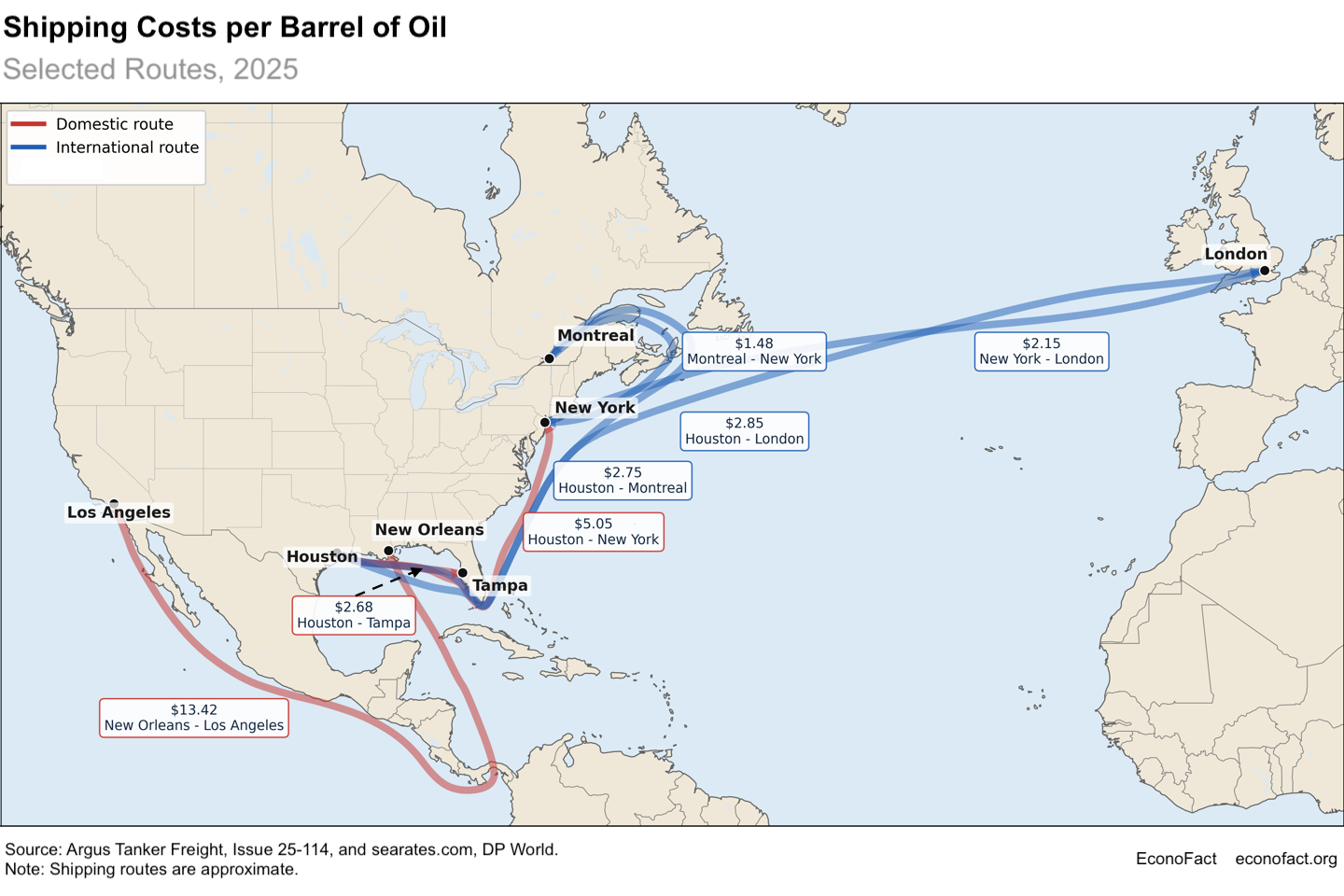
- The Jones Act raises the cost of transporting goods between American ports. For example, the cost of shipping a barrel of crude oil from Houston to Jacksonville is more than double that of shipping a barrel the shorter distance from Montreal to New York/New Jersey, and the cost for shipping a barrel of crude oil from New Orleans to Los Angeles is more than four times that of shipping a barrel the comparable distance from Houston to London (see chart). Similarly, the Federal Reserve Bank of New York found in 2012 that the shipping cost for a twenty-foot container from the mainland United States to Puerto Rico was $3,063, but only $1,503 for the same container from the mainland United States to the Dominican Republic. A 1988 study by the Government Accounting Office (GAO) on the effects of the Jones Act on Alaska, which depends much more on shipping than the contiguous 48 states, estimated extra shipping costs of $163 million per year for goods shipped between Alaska and the mainland United States. The ban on the transportation of liquefied natural gas by foreign-flagged ships raises the price paid by the Puerto Rico Electric Power Authority by as much as 30 percent. Overall, the World Economic Forum estimates that preventing foreign ships from transporting cargo between United States ports costs the United States economy $200 million per year in extra shipping costs.
- The lessons from these statistics are reinforced by particular examples. In the severe winter of 2014, the New Jersey Department of Transportation ran short of road salt. A 40,000-ton pile of road salt was available 400 miles away, on the coast of Maine, near a vessel that could transport it. But this foreign vessel, which was not Jones Act-compliant, was banned from completing the delivery and ultimately the shipment was both delayed and more than double what it would have cost had the foreign-vessel been able to deliver it. Another example is that lumber products on the East Coast of the United States are purchased from Western Canada, rather than from Washington State or Oregon, because of the higher transportation costs due to the Jones Act. Finally, a cattle rancher in Hawaii sends his cows to the mainland United States on airplanes, rather than ships, because of the sea transportation expenses associated with the Jones Act.
- The provision of the Jones Act that requires ships to be built in the United States raises costs. A century after the Jones Act was passed, American shipbuilding has become increasingly uncompetitive: it now costs four to five times more to build a large merchant ship in the United States than it does to build one in Asia. Three container ships being made in Philadelphia cost $330 million each, while similar vessels bought from an Asian shipyard would cost $75 million at the most, according to a recent article. Production of large commercial vessels in the United States has practically disappeared. As a result, the fleet of ships eligible for use under the Jones Act in the United States has been shrinking, from 181 ships in 2000 to 93 ships by 2019. This means that the Jones Act requirement that all goods be transported on American-built ships has become more onerous over time (see here).
- While the Jones Act makes gasoline and other petroleum products more expensive in some domestic markets in the United States, especially along the East Coast, waiving the act leads only to modest savings. The impact of suspending Jones Act requirements on domestic prices for petroleum products varies by geographic area, according to recent research by economists Ryan Kellogg and Richard L. Sweeney. Much of the United States’ oil and gas resources and refining capacity are located in Texas and the gulf coast. But, the large population centers along the US East coast import large amounts of fuel from across the Atlantic, rather than having fuel products shipped from Texas and the gulf. Eliminating the Jones Act would reduce shipping costs from oil producers in Texas to consumers along the East Coast. However, Kellogg and Sweeney estimate that if the Jones Act had been eliminated, US East Coast prices for gasoline would have decreased on average by $0.63 per barrel ($0.015 per gallon) during the year 2018–2019 with price decreases being the largest in the Southeast and lowest in New England. While East Coast refined product consumers would benefit in aggregate by an estimated $802 million in that year, the sum amounts to only a few dollars per year per person. (Gasoline prices in the Gulf Coast would increase as a result of the greater exports to the East Coast by an estimated $0.30 on average, per barrel).
What this Means:
The original motivation of the Jones Act was based on national security concerns, and these reasons continue to be advanced today. But cargo shipping by air is possible today, which was not the case in 1920. Also, only one of the five shipyards that produce major vessels for the Navy and Coast Guard builds commercial vessels that are Jones Act compliant. The ongoing enforcement of the Jones Act provides a particular example of how restrictions on trade benefit a very small group of producers at the expense of a vastly larger group of consumers. There is political support for these types of restrictions because the benefits are concentrated while the costs are much more diffuse; in this case, the beneficiaries are the owners and workers in the U.S. shipbuilding and industries while the costs are borne by consumers of shipping services, especially those in places like Alaska, Hawaii and Puerto Rico that disproportionately depend upon those services. The costs of this act become particularly apparent at times of acute crisis, but its ongoing costs endure in more normal times and generate a structural impediment for places like Puerto Rico, as well as an overall burden on U.S. consumers. If suspending the Jones Act is considered good policy when shipping cost increases are most salient — such as after hurricanes or during the current oil price shock—it stands to reason that a permanent suspension would be even more beneficial, as the act imposes those same costs even when they are less noteworthy.