
How Tighter Curbs on Immigration Impact the U.S. Economy
EconoFact

The Issue:
Immigration has historically been an important driver of U.S. population growth, particularly in recent decades as immigration numbers surged and fertility rates of native-born Americans declined. As a result, immigrants have made up a growing share of the nation’s workers. The impact of immigrant workers is large at both the low- and high-skill ends of the labor force. Immigrants represent a high share of workers in many low-wage, manual labor sectors of the economy. At the same time, immigrants contribute importantly to high-level technical skills and entrepreneurial energy. Most recently, however, government policies have aimed at drastically curtailing the inflow of immigrants and increasing the outflows of foreign-born persons. What are the different ways that this shift might impact the US economy?
The recent decline in immigration could adversely affect the economy through multiple channels, short term and long term.
The Facts:
- High rates of immigration have driven a fivefold increase in the number of foreign-born persons living in the United States over the past six decades. All told, the number of immigrants rose to 53.3 million in January 2025 (about 15.8 percent of the population), up from under 10 million in 1965 (about 5 percent of the population). High rates of immigration in part reflected legislation in the 1960s that opened pathways to legal immigration to a much wider and diverse set of countries. Since 2000, the population of highly-educated foreign-born workers grew at an especially strong rate, as they were well-placed to obtain permanent residence status and then naturalization (see here). More recently, since 2021, there was a sharp increase in the population of unauthorized immigrants (those without full legal status, which includes people who entered the United States illegally and people who were allowed to enter through the use of parole authority and who may be awaiting proceedings in immigration court.) As COVID-related restrictions on border crossings were eased, many immigrants received temporary paroles or deportation protection as asylum seekers, victims of crime and violence, and refugees from countries facing war and natural disasters. The estimated population of unauthorized immigrants jumped from 10.2 million in 2019 to a record high of 14 million in 2023. Looking at the 2023 foreign-born population (the last year for which complete data is available), 46 percent were naturalized U.S. citizens, 27 percent were lawful residents with permanent or temporary residence permits, and 27 percent were without full legal status (of which 40 percent had parole or some other form of protected status).
- However, recent shifts in government policies have led to a sharp reversal in net immigration flows, as the number of new immigrants has been sharply curtailed and aggressive actions have been taken to repatriate unauthorized immigrants living in the United States. The annual net flow of immigrants peaked at 3.4 million people in 2023, far above the previous peak of over 1.5 million in 2014 (see chart). Starting in mid-2024, however, entries through the various asylum and parole programs were limited by the Biden administration. Since January 2025, the Trump administration has gone further in removing deportation protections, rescinding work permits, stopping accepting asylum applications, halting the release of immigrants encountered at the border, while intensifying repatriation efforts of unauthorized immigrants living in the United States. There is a high degree of uncertainty in the estimates for net immigration flows for 2025. The Congressional Budget Office estimated in September 2025 that net immigration would still be positive but drop sharply to 0.4 million (see chart). Other estimates suggest a decline of foreign-born people living in the United States. For instance, according to a Pew Research Center analysis, the total number of foreign-born persons living in the United States dropped by over 1.4 million from January 2025 to July 2025, although the decline may be exaggerated by increasing reluctance of unauthorized immigrants to participate in population surveys.
- As the share of foreign-born workers has risen, variations in net immigration rates have substantial consequences for the U.S. workforce. Since 1995, the population of foreign-born workers has grown 2.8 percent per year and the native born by only 0.6 percent per year. In consequence, net immigration has accounted for close to half of labor force growth, pushing the share of foreign-born workers up to 19.2 percent of the work force in 2024 from under 12 percent in 1995 (Pew). The growing importance of immigrants in the labor force is a result of immigration trends, but it is also a reflection of the increasing retirement of the baby boom generation and low U.S. birth rates.
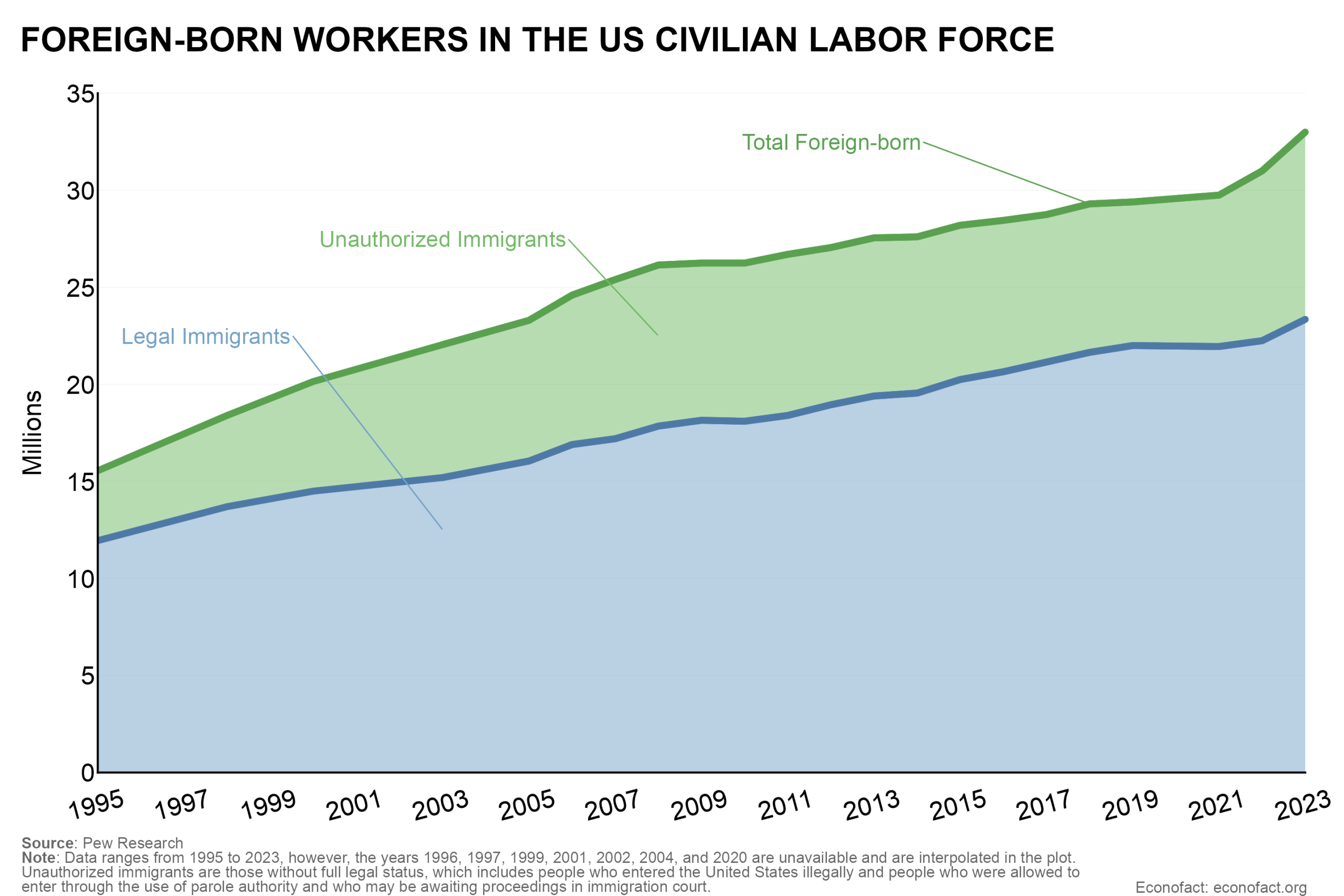
- A sharp slowing or even reversal of the growth of the U.S. labor force would have a significant negative impact on employment and GDP growth. The speed at which the economy can grow over a longer horizon is determined by changes in the total amount people are working — which involves both the number of workers in the labor force and the hours they work — and the efficiency with which they produce goods and services. Estimates of the negative impact of a reduction of labor force growth on GDP growth depend on the assumptions made on the drop in net migration, but the order of magnitude is similar across studies. A recent AEI study of this impact was based on projections that the net change in the population of immigrants over age 16 will be in the range of -525,000 to 115,000 in 2025, down from 2.2 million in 2024. The analysis suggested that this shift would reduce GDP growth in 2025 by 0.3 - 0.4 percentage points as potential growth in employment is cut from 140,000-180,000 jobs a month in 2024 to 10,000-40,000 jobs a month in the second half of 2025. (Potential employment growth means employment growth when the labor market is operating at full capacity, setting an effective speed-limit for non-inflationary growth.) Other studies with different assumptions give estimates of a similar magnitude (here and here)
- Beyond the aggregate numbers, foreign workers make a particular contribution in low-wage, manual labor sectors of the economy where U.S. citizens typically prefer not to work, thus helping to relieve shortages and contain inflation — this benefit is now at threat of being reversed. Immigrant workers account for 43 percent of farm workers, 30 percent of food production and processing workers, 28 percent of construction workers, 22 percent of workers in personal services, and 20 percent of workers in the leisure and hospitality sector (see here). A substantial portion of these jobs are filled by undocumented workers — for example, 42 percent of crop workers are undocumented because of limits on the H2A temporary visa program for farm workers and the lack of interest by U.S.-born workers. A disruption in the availability of undocumented migrant workers will tend to raise costs and create supply shortages. This was well demonstrated in the two years after the COVID 19 shock when COVID-related immigration disruption led to a shortfall of 1.65 million in the working-age immigrant population, a gap that was not filled by increasing employment of native-born workers. While immigration subsequently rebounded post-COVID, a recent U.S. Government report suggests that recent efforts to curb the influx and to repatriate undocumented workers is again disrupting production in sectors like the food industry, adding to pressures on food price inflation. In turn, higher food prices fall most heavily on low-income households, which spend a higher percent of their earnings on food. The elderly and infirm population is also at particular risk because of their reliance on homecare and medical services often provided by foreign workers.
- At the other end of the spectrum, highly educated foreign-born workers, often arriving as students, have made major contributions to the U.S. economy by bringing in skills, expertise and entrepreneurial energy. The contribution may be most obvious with truly exceptional immigrants — people like Sergei Brin (Google), Elon Musk (Tesla), Jensen Huang (Nvidia), Sundar Pichai (Alphabet) and Satya Nadella (Microsoft) — who have founded or run the major tech firms that have recently been critical sources of strength of the U.S. economy. Less well known perhaps but just as important are the talented software engineers who have come from abroad to help to build the technical infrastructure for these companies, often after U.S. university education. Foreign- born workers accounted for 80 percent of the growth in college-educated STEM (science, technology, engineering and mathematics ) workers as a share of all employment between 1990 and 2010. Moreover, the influx of these workers is estimated to have benefitted native workers too (both with and, to a somewhat lesser extent, without college degrees) through increased productivity and wages. U.S.-based immigrants account for 16 percent of the inventor workforce but 23 percent of patents and 32 percent of total U.S. innovative output since 1990, according to recent study. Cutting back on student visas and the recent large increase in fees on H1B visas for foreign professionals with specialty skills could both undercut the U.S. ability to attract top talent and help other countries (including competitors in Europe and Asia) to build up their own university research systems and rival tech industries, undercutting core strengths of the U.S. economy.
- While changes to the rate of immigration have a complex fiscal impact, careful projections suggest that on balance, higher immigration tends to reduce the government deficit and support social security payments for the retired. Whether an individual immigrant contributes more in taxes than they receive in government benefits and services depends on their age, working status, and dependent children, and this balance will vary over time as the immigrant and their children age. Children and older persons who are not likely to be working and receive education and health benefits will tend to be net beneficiaries of government expenditures. However, since most immigrants tend to be of working age, a typical immigrant brings a net short-term budget dividend across all levels of government by contributing more to tax revenue than the additional government expenditures incurred (see here). This is true for undocumented immigrants who do not qualify for most safety-net benefits but they do pay taxes (including payroll and sales taxes, for instance). This short-term benefit of immigrant workers translates into long-term present value gains to the budget even accounting for higher government costs as migrants get older and eventually retire themselves. A recent Congressional Budget Office study found that the surge in immigration starting in 2021 would be expected to lower the overall federal budget deficit significantly over 2024-34. Conversely, recent efforts to curtail immigration flows will tend to raise the fiscal deficit and debt trajectories, as U.S. population growth estimates are revised down.
What this Means:
Foreign-born workers have made a critical contribution to the U.S. economy in recent decades because they have added to the overall human resources of the economy, at a time when the growth of the U.S. native-born population was slowing. As a result, the economy has grown faster, while jobs and real wages of native-born Americans have benefitted from the boost to overall productivity as foreign-born workers bring complementary skills and as prices for food products and many services have been contained. Moreover, by adding to the labor force and the tax base, immigration has also helped to bolster the U.S. fiscal position and support social security for the retired. However, recent curbs on immigration have already contributed to a slowdown in employment growth and added to pressures on food prices. If these curbs are extended and intensified in the years ahead, the long-term health of the U.S. economy would take a hit as per capita GDP growth would slow, the U.S. technology lead over the rest of the world could be eroded, and an already precarious fiscal position would be further weakened.
Like what you’re reading? Subscribe to EconoFact Premium for exclusive additional content, and invitations to Q&A’s with leading economists.