
The Costs of Continuing Coal-Fired Power in the United States
Resources for the Future
The Issue:
The use of coal to generate electricity in the United States declined sharply over the past two decades, displaced by natural gas, renewables and nuclear sources. Until recently, coal generation was expected to continue declining such that carbon dioxide emissions from coal were projected to drop significantly by the early 2030s. However, expected increases in electricity demand — driven by data center growth and climate change — as well as a flurry of policy actions taken by the Trump administration to support coal-fired electricity generation, are slowing or arresting the pace of coal’s decline. While coal is unlikely to go back to making up a major share of U.S. electricity generation, the fuel’s slower or arrested demise is likely to have negative impacts on electricity ratepayers, plant owners, air quality, public health, and climate.
While coal accounted for only 15% of U.S. electricity generation in 2024, it accounted for almost half of carbon dioxide emissions from the power sector.
The Facts:
- Due to economic drivers and environmental regulations, the U.S. reliance on coal for electricity generation has been greatly reduced. In the early 2000s, coal generated around 50 percent of the electricity consumed in the United States. By 2025, coal accounted for 17 percent of the nation’s electricity generation (author's calculations using data from EIA Monthly Energy Review). A combination of market pressures and federal and state environmental regulations and policies drove this decline in electricity generation from U.S. coal-fired power plants. The rapid expansion of domestic shale gas production via hydraulic fracturing (fracking) significantly lowered the relative price of natural gas, causing utilities to switch from coal to more efficient natural gas combined-cycle generation. At the same time, the cost of wind and solar was declining, making them cost-competitive against an aging, less efficient domestic coal fleet, while also offering a less environmentally damaging option for electricity generation. Compliance with federal environmental regulations such as the Mercury and Air Toxics Standards and the Cross-State Air Pollution Rule required operators to balance large capital costs for pollution controls against early retirement, with many operators of older plants choosing plant retirement. Coupled with flat overall electricity demand and state-level renewable portfolio standards, these market dynamics and regulatory requirements altered power sector economics and accelerated the retirement of more than 80,000 megawatts of coal capacity, which is enough to power almost 49 million homes (author’s calculations based on EIA 2020 estimates of 14,300 KWh per year electricity consumption for the average home).
- But expected changes in future electricity needs — coupled with the volatility in the price of natural gas — are now increasing the likelihood that coal units remain operational for longer. The rapid growth of artificial intelligence is increasing demand on U.S. electricity generation. Data centers are projected to consume up to 17 percent of U.S. electricity by 2030. This increased electricity demand may not result in long-term viability of coal units, but keeping coal units in operation is increasingly being seen by utilities as insurance against shortages in baseload and peak generation while natural gas, nuclear, geothermal, solar, and wind are built out and connected. Similarly, climate-driven increases in heating and cooling demands mean that utilities may continue operating coal units longer than was previously expected. The effects of climate change on electricity demand can be insidious: as climate change shifts the entire temperature distribution, including increased nighttime temperatures, it could increase energy demand in the southern U.S. by 25 percent by 2050. The effects can also be sporadic (e.g. during winter storms or heat waves), leading to temporary increases in coal-fired generation, especially if natural gas prices are high: U.S. annual coal generation increased by 13 percent in 2025, reversing years of decline as a result of winter temperatures and high natural gas prices.
- The Trump administration has instituted a flurry of actions intended to encourage and in some cases force coal plants to stay operational and to favor coal-fired generation more broadly. The U.S. Department of Energy (DOE) has issued and repeatedly renewed emergency orders under the Federal Power Act, that require at least six coal-fired power plants to continue operating. In addition, the Trump administration has issued Executive Orders focused on maintaining or expanding coal generation and ordering the Department of Defense to prioritize purchase of coal-generated electricity; initiated implementation delays and proposed rollbacks of regulations on air and water pollution from coal-fired plants; and revived the National Coal Council to promote the domestic production of coal and coal-fired generation (see here for a timeline of policies). The Department of the Interior has opened 13.1 million acres of federal land to coal leasing. And the Trump administration has also announced new federal funding to boost the energy production from coal with an announced $625 million in September, 2025 and an additional $775 million to extend the life of coal plants that might have otherwise closed, build new coal-fired plants in Alaska and West Virginia, and recommission an already retired plant in Maryland on June 4, 2026.
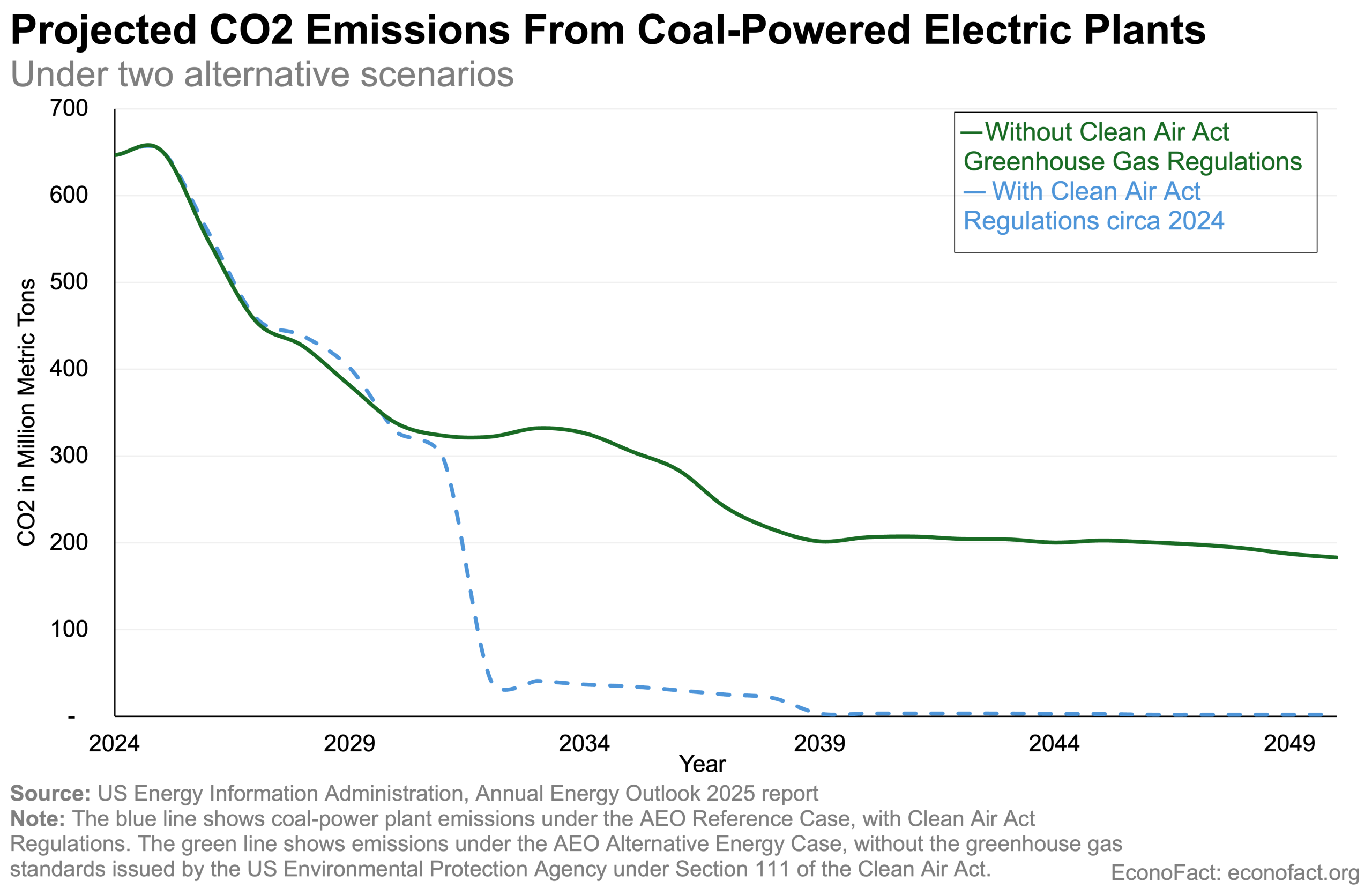
- Trump administration efforts to weaken or eliminate greenhouse gas and air pollution regulations on coal-fired plants, coupled with other policy actions intended to encourage the use of coal for electricity, are changing the scenarios for coal-fired electricity in the United States. Prior to the start of the second Trump administration, projections from the Energy Information Administration showed that coal-fired generation would fall to close to zero by 2032 with the greenhouse gas limits promulgated under section 111 of the Clean Air Act. If the Trump administration succeeds in its effort to repeal these greenhouse gas emission standards, it would result in continued coal-fired generation of 200 TWh to at least 2050 with carbon dioxide emissions continuing at around 200 million metric tons per year (see chart). And this doesn't account for the impacts of relaxing other power plant regulations, such as the Mercury Air Toxics Standards or the Good Neighbor Plan for the 2015 Ozone National Ambient Air Quality Standards.
- Coal’s disproportionate climate and pollution impacts are costly. While coal accounted for only 15 percent of U.S. electricity generation in 2024, it accounted for almost half of carbon dioxide emissions from the power sector. The plants that remain open or are delaying retirement are continuing to emit carbon dioxide, sulfur dioxide, nitrogen oxides, particulate matter, and mercury. The 2025 increase in coal-powered generation was accompanied by increases in SO2, NOx, and CO2 emissions of 15, 11, and 10 percent respectively (author’s calculations based on data from EPA’s Clean Air Markets Data). Resources for the Future estimates that the Trump administration’s proposed rollback of the greenhouse gas standards for fossil-fuel powered electricity generation units would cumulatively result in an additional 4,125 million metric tons of carbon dioxide emissions — a social cost of over $800 billion using the Environmental Protection Agency’s 2023 social cost of carbon. Emissions of sulfur dioxide, nitrogen oxides, and particulate matter affect ambient concentrations of ozone and particulate matter, which are linked to serious health effects including asthma-related emergency department visits, heart attacks, respiratory and cardiovascular hospital admissions, and premature death. A study by Henneman et al (2023) estimated 460,000 premature deaths in the U.S. are attributed to coal-fired power plant emissions from 1999–2020.
- Keeping aging coal plants running also means that costs will increase for ratepayers and plant operators. Direct costs of keeping plants ready to retire operational have already run into hundreds of millions of dollars, due to required repairs for nonoperational units, high maintenance costs for aging equipment, staffing costs, fixed expenses, and generation costs that exceed revenues. Due to federal rules allowing utilities to pass on operational and maintenance expenses to residential and commercial consumers, ratepayers are on the hook for any cost increases incurred by utilities. For example, the J.H. Campbell coal-fired plant in Michigan owned by Consumers Energy, has been required to stay operational under Department of Energy emergency orders. While the state of Michigan and environmental groups challenged the emergency orders in court, the plant owner has filed a request with the Federal Energy Regulatory Commission (FERC) to recover $180 million in compliance costs for the emergency orders through March 2026, and the costs will continue with every extension of the emergency order.
What this Means:
There is considerable uncertainty regarding the trajectory for coal in the United States. While the Trump administration continues to prop up aging coal-fired power plants, some states, like Colorado and Michigan, are challenging federal orders to keep coal-fired power plants open. State pollution standards, state renewable portfolio standards, and federal pollution regulations are still on the books. Building new coal-fired plants or keeping older plants operational and compliant with environmental regulations requires investments that will not realize returns for years, and concerns from plant operators and investors that future administrations may reverse course pose additional challenges. Meanwhile, diverting federal dollars to prop up coal-fired plants means less resources available for other energy investments. Underinvesting in renewables means less new generation coming online to meet increasing data center demand, which will drive up electricity prices. The uncertainty in how future energy demands will be met, coupled with the Trump administration's trajectory for deregulation, means that operators of coal-fired plants may choose to keep those plants operational for years to come. Every year that coal is burned more carbon dioxide is emitted to the atmosphere, which (without significant new technologies) will remain there for thousands of years. The direct costs of delaying retirements for older coal-fired units are substantial, and ratepayers will in most cases end up footing the bill. The indirect costs from worsened air quality and increased carbon emissions will be borne by all of us, including future generations.
Like what you’re reading? Subscribe to EconoFact Premium for exclusive additional content, and invitations to Q&A’s with leading economists.