
State Abortion Bans and Adolescent Suicide Risk
Verge Research, Georgia Institute of Technology and National Bureau of Economic Research
The Issue:
In June 2022, the Supreme Court's decision in Dobbs v. Jackson Women's Health Organization overturned Roe v. Wade and allowed states to ban abortion. Within months, a number of states had implemented total abortion bans that effectively eliminated legal access. Recent research shows that the consequences of these bans reach well beyond abortion access itself: studies point to shifts in where people choose to live and in local housing markets, and to worse mental health, including greater psychological distress, anxiety, and depression among reproductive-age women. Far less is known about how the bans affect adolescents, who may be disproportionately impacted. Compared with older reproductive-age women, pregnancies to teenage girls are more likely to be unintended and, while pregnant teens are more likely to want to terminate their pregnancies, they are also more likely to face financial and logistical barriers to the care involved. Adolescence is also a developmental stage when mental health is especially sensitive to stress. In new research, we examine whether total abortion bans are linked to changes in suicidal thoughts or behaviors among adolescent females.
Total abortion bans increased the share of female high school students reporting suicidal thoughts by about 4.3 percentage points, relative to states without bans.
The Facts:
- The Dobbs decision produced sharp, state-level differences in abortion access that rapidly took effect. Following the ruling, total abortion bans took effect almost immediately in several states. Among the states in our sample with the survey data needed for the analysis, five had total bans in place by the time of the 2023 survey: Arkansas, Missouri, and Oklahoma, where bans took effect in June 2022, and Tennessee and Texas, where they took effect in August 2022. We compare trends in suicidal ideation and suicide attempts among female high school students in these states with those in ten states that did not implement bans during the study period: Maryland, Michigan, Montana, Nebraska, Nevada, New Hampshire, New Mexico, North Carolina, North Dakota, and Pennsylvania.
- Teenage girls may be particularly vulnerable to changes in laws governing abortion access. Pregnant teenagers often face disproportionate barriers to accessing abortion care, including difficulties with transportation, financial limitations, and parental involvement requirements. These challenges are magnified by the changes in abortion laws. Loss of abortion access may affect adolescent mental health by increasing uncertainty and reducing their perceived control over their future life trajectories. This is consistent with research that finds that women denied an abortion are more likely to experience economic hardship and economic insecurity lasting years than otherwise similar women who received an abortion. Adolescent suicide is a major psychiatric and public health concern, with suicide being the second leading cause of death among individuals aged 10 to 24 in the United States.
- Abortion bans are associated with adverse health and mental health outcomes among reproductive-age women. A growing number of studies have been examining the impact of abortion bans and there is accumulating evidence that the bans are associated with pregnancy-related morbidity and infant mortality, as well as mental distress. Studies have found an association between reduced abortion access and suicide deaths among reproductive-aged women (see here and here). But no previous study has examined whether total abortion bans are associated with suicidal thoughts or attempts among adolescents.
- Our analysis draws on a large, standardized survey of high school students conducted before and after the bans. We use the Centers for Disease Control and Prevention’s Youth Risk Behavior Survey (YRBS), an anonymous, school-based questionnaire administered biennially to students in grades 9 through 12. Two self-reported outcomes are measured over the prior 12 months: suicidal ideation, which is defined as seriously considering suicide or making a plan to attempt suicide, and suicide attempts. We analyze female and male students separately, with male students analyzed for comparison since they would not be expected to respond to the bans through the same channels as female students.
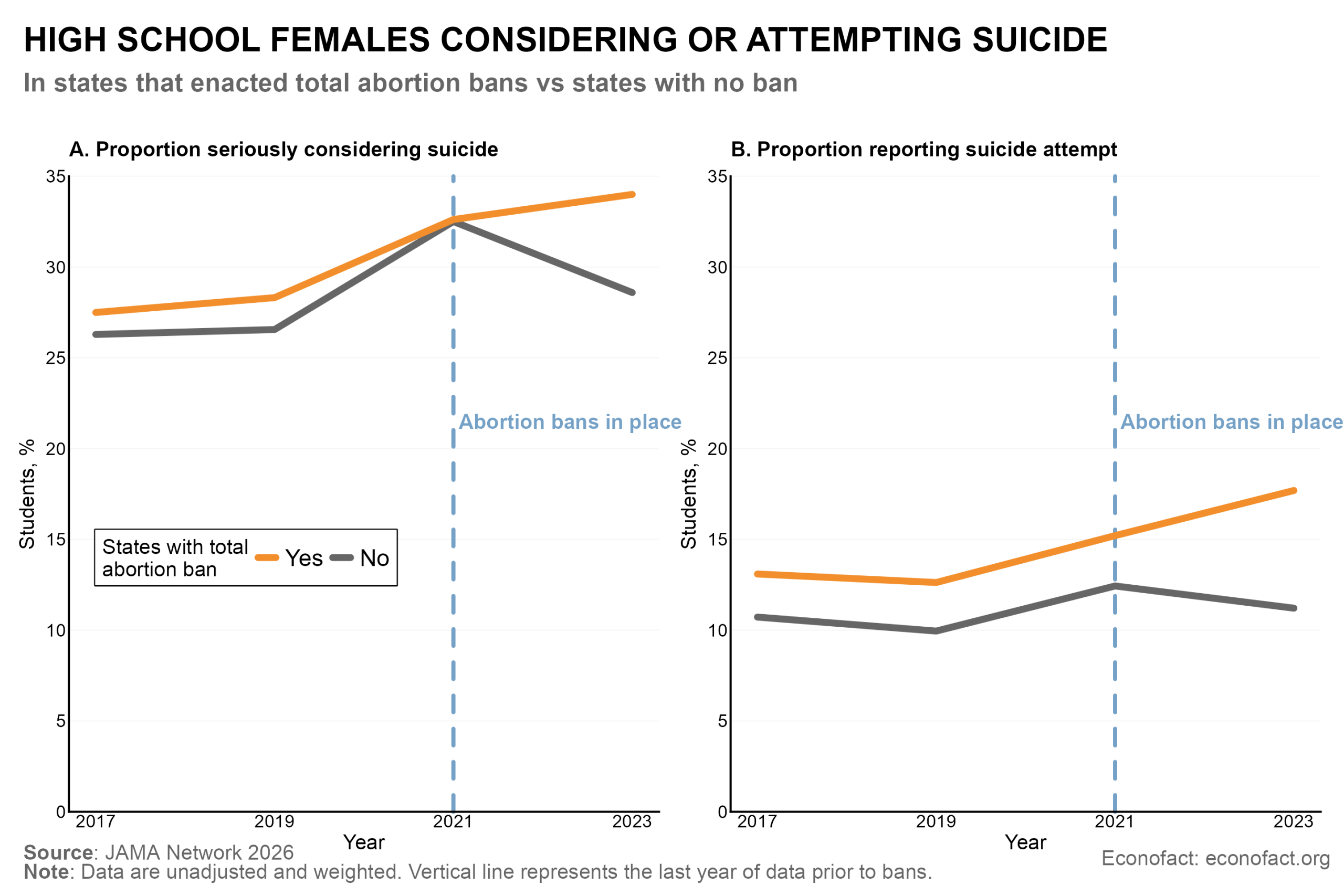
- Before Dobbs, the suicide indicators in the two groups of states moved in tandem; in 2023, they diverged. Across the survey waves leading up to the decision, the share of female students reporting suicidal thoughts and attempts followed similar trajectories in states that would and would not go on to ban abortion. That changed after the bans took effect. Between the last pre-policy survey in 2021 and the first post-policy survey in 2023, reported suicidal ideation among female students in ban states held roughly steady, moving from about 33 to 34 percent, while attempts rose from about 15 to 18 percent. Over the same period in states without total bans, both fell. In particular, ideation fell from about 33 to 29 percent and attempts fell from about 12 to 11 percent (see chart).
- To determine whether the abortion bans caused the divergence in trends among the states, we compare the change over time in ban states with the contemporaneous change in states without bans. This difference-in-differences approach asks whether suicidality among female students rose in ban states by more than it did in other states over the same window, while accounting for fixed differences across states and for nationwide shifts affecting all students. Its credibility rests on the two groups having moved in parallel beforehand, which the data support. We also adjust for students’ race and ethnicity, grade in school, and state-level COVID-19 mortality.
- Among female students, total abortion bans increased suicidal thoughts; the estimated effect on suicide attempts pointed the same way but was less precise. The bans increased suicidal ideation among female students by 4.3 percentage points relative to states without bans. The estimated effect on suicide attempts was similar in magnitude, at 3.2 percentage points, but less precise and not statistically significant. As expected, abortion bans did not have a statistically significant effect on suicidal ideation or suicide attempts among male students who are less directly impacted by pregnancy. These results suggest that the policies implemented in ban states adversely affected female students’ mental health. However, it is important to keep in mind that the survey captures different students in each wave so the analysis does not observe the impact of bans on a given set of individuals over time. It is also possible that differential changes in participation rates in the survey between ban and non-ban states after Dobbs could have affected the results.
- Several mechanisms could plausibly link the bans to adolescent distress. The data cannot pin down why suicidal thoughts rose, but the Dobbs decision and the bans that followed were highly publicized. A survey conducted before the ruling found that most adolescents were aware of the potential changes to abortion access and reported anger, fear, and sadness. These emotions have been associated with increased suicide risk among adolescents in prior research. Beyond those directly facing an unwanted pregnancy, a diminished sense of control over one’s future may itself be a source of distress.
What this Means:
Our findings add adolescent mental health to a growing list of outcomes that move when states ban abortion — alongside earlier evidence that bans led to population outflows from, and softening housing markets in, the states that adopt them. Suicidal thoughts among female high school students increased where total bans took effect relative to places where they did not. Suicide attempts moved in the same direction, though the adjusted estimate was less precise and did not reach conventional levels of statistical significance. The absence of any effect among male students and the parallel pre-policy trends point to abortion policy itself, rather than other differences between these states, as the causal factor responsible for these changes. As a whole, these results indicate that the effects of total abortion bans extend beyond reproductive and economic outcomes to the mental health of adolescent females. Because these data capture only the first year in which the bans were fully in force, more research will be needed to learn how these effects evolve.
Like what you’re reading? Subscribe to EconoFact Premium for exclusive additional content, and invitations to Q&A’s with leading economists.