
Does the World Produce Enough Healthy Food?
Michigan State University
The Issue:
Poor diet quality is one of the world’s stubborn public health problems, with diet-related diseases resulting in an estimated 11 million premature deaths around the world in 2017. Healthy diets are important for lifelong health and can help protect against cardiovascular disease, diabetes, and certain types of cancer while improving overall mental and physical health. Although there has been meaningful improvement in key measures of malnutrition, obesity rates are climbing in many countries while micronutrient deficiencies remain significant, especially among women and young children. A central question for policy makers is whether food systems are capable of producing enough healthy foods to meet the nutritional needs of the world’s population. New analysis discussed in this memo compares global food production with benchmarks for health, and explores whether near-term investments in agriculture are likely to bring food systems toward closer alignment with dietary guidelines.
Consuming fruits, vegetables, legumes, nuts, and seeds is important for protection against heart disease, diabetes, and certain cancers.
The Facts:
- There is a broad consensus about the foods that we should eat for lifelong health. These central findings have been summarized to create the Healthy Diet Basket (HDB) framework, which reflects the food-based dietary guidelines that governments use to communicate evidence-based nutrition principles to a general audience. According to the HDB, about 50% of dietary energy should come from starchy staples, like rice, wheat, corn, or potatoes. About 13% of energy should come from each of three additional food groups: animal-source foods; legumes, nuts, and seeds; and oils and fats. Finally, fruits should provide about 7% of dietary energy, and vegetables should provide about 5%. People can meet these requirements by eating the locally available and culturally meaningful items that they prefer within each food group. However, foods that contain high amounts of sodium, saturated fat, or added sugars are not recommended as part of a healthy diet.
- Diets can have profound consequences for physical and cognitive health throughout the lifespan. Traditional measures of malnutrition focused on obtaining enough energy for survival and enough essential vitamins and minerals to avoid deficiencies. Avoiding micronutrient deficiency remains a key concern, especially for children and for women of reproductive age. However, malnutrition is now understood more broadly. Public health nutrition experts place special emphasis on whether a person consumes foods from a variety of healthy food groups while avoiding or limiting less healthy foods. Consumption of fruits, vegetables, and legumes, nuts, and seeds is especially important for protection against diet-related diseases such as cardiovascular disease, diabetes, and certain cancers. Excess consumption of food groups that are otherwise recommended for health may displace fruits, vegetables, and legumes, nuts, and seeds from the diet. In other cases, people may consume specific foods that are directly linked with health risks, such as cured and processed meats, foods high in added sugar, or deep-fried foods. In both cases, poor diet quality over time increases the risk of diet-related disease. More generally, consistently eating food in excess of the necessary amount leads to excess weight and obesity, regardless of whether the foods consumed are healthy.
- About one third of the world’s population cannot afford a healthy diet, with animal-source foods, fruits, and vegetables especially out of reach. The World Bank and the Food and Agricultural Organization (FAO) track the cost of healthy diets around the world using the HDB system. In 2024, the average cost to purchase a healthy diet was $4.41 in low-income countries and $4.22 in high-income countries. These estimates are expressed in purchasing power parity (PPP) dollars, which are adjusted for differences in the local cost of goods and services and allow for direct comparisons across countries. Animal-source foods were the most expensive at $1 per day, followed by vegetables at $0.76 per day and fruits at $0.67 per day. On average, people in low-income countries have only $1.35 available for food spending after accounting for non-food essentials, which means that the cost of a healthy diet is unaffordable for many households. In contrast, healthy diets are affordable for nearly all people in wealthy countries like the United States, where the average low-income household spent about $14.46 per day on food in 2023. Although the concept of food deserts has gained substantial attention in recent years, evidence shows that physical proximity to grocery stores is not a meaningful driver of diet quality. Instead, the convenience and appeal of less healthy foods—made plentiful through fast food restaurants and convenience stores in “food swamps”—make healthy diets a more difficult choice for households at all income levels.
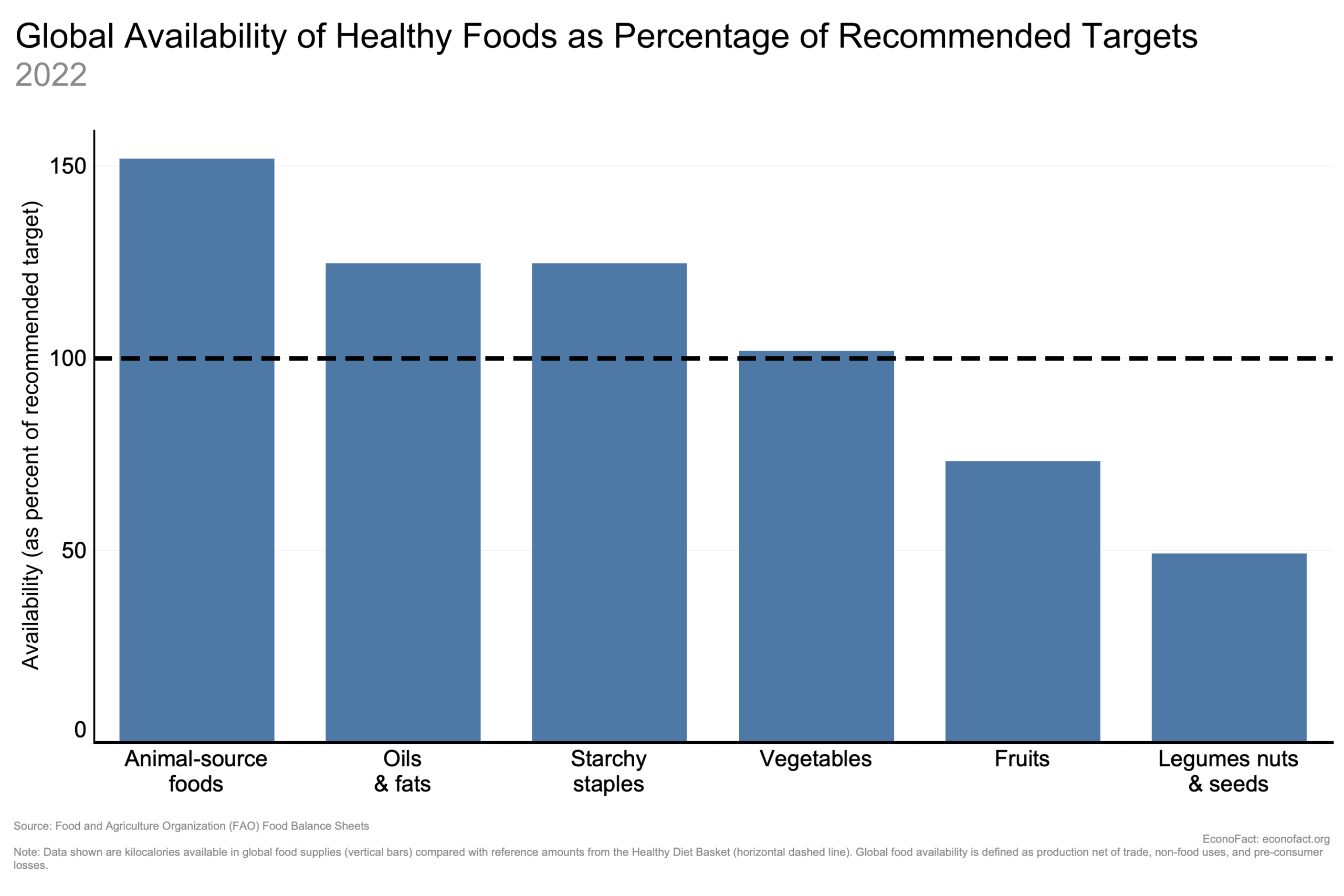
- Global food systems produce enough energy for the world’s population to survive on basic foods like grains and oil, but fall far short for other food groups. In our analysis of food supply data from FAO, we compare the global (see chart) and regional availability of foods with the recommended daily intake from the 6 HDB food groups. On average, the total energy available from starchy staples, animal-source foods, vegetables, and oils and fats is sufficient to meet the needs of all people around the world, while energy available from fruits and from legumes, nuts, and seeds remains well below recommended levels.
- Global averages mask substantial regional variation, with food supplies in wealthier regions eclipsing recommendations for some food groups while poorer regions fall short. Geographic disparities mean that people in Sub-Saharan Africa and South Asia have limited access to animal-source foods and oils and fats even as people in North America and other wealthier regions enjoy more than five times the recommended amount. Large shortfalls for fruits, vegetables, and legumes, nuts, and seeds are especially pronounced in low-income regions.
- Projections indicate that these shortfalls will persist under climate change, even if the international community mobilizes funding to counteract climate-related hunger. Global availability of all food groups except legumes, nuts, and seeds has remained stable or increased consistently since 1961, when data collection began. However, when we link historic food supply data with projections through 2050, we find that improvements in the food supply are expected to level off. Climate change is certain to increase global rates of chronic hunger, but traditional agricultural investments aimed at maintaining the supply of calories from basic staple foods will not be enough to improve the availability of undersupplied foods.

What this Means:
Sufficient food is available in the world for all people to consume sufficient calories, but not healthy diets. Although food systems have made substantial progress toward health over the last six decades, we cannot expect this progress to continue indefinitely. We need new investments in research and development to improve production of the foods that are most in need: fruits, vegetables, legumes, nuts, and seeds. New investments are especially needed in Sub-Saharan Africa and South Asia, as well as in other parts of the world that are vulnerable to climate change. Policy makers must also focus on improving the affordability of healthy diets in low-income countries by creating income growth through employment and social safety nets, which in turn will create demand for under-consumed foods. Most importantly, in countries across the income spectrum, marketing, education, and other consumer-facing interventions will be necessary to convince people that healthy diets are appealing.
Like what you’re reading? Subscribe to EconoFact Premium for exclusive additional content, and invitations to Q&A’s with leading economists.