
Do State Abortion Bans Affect Housing Markets?
Georgia Institute of Technology and College of Wooster
The Issue:
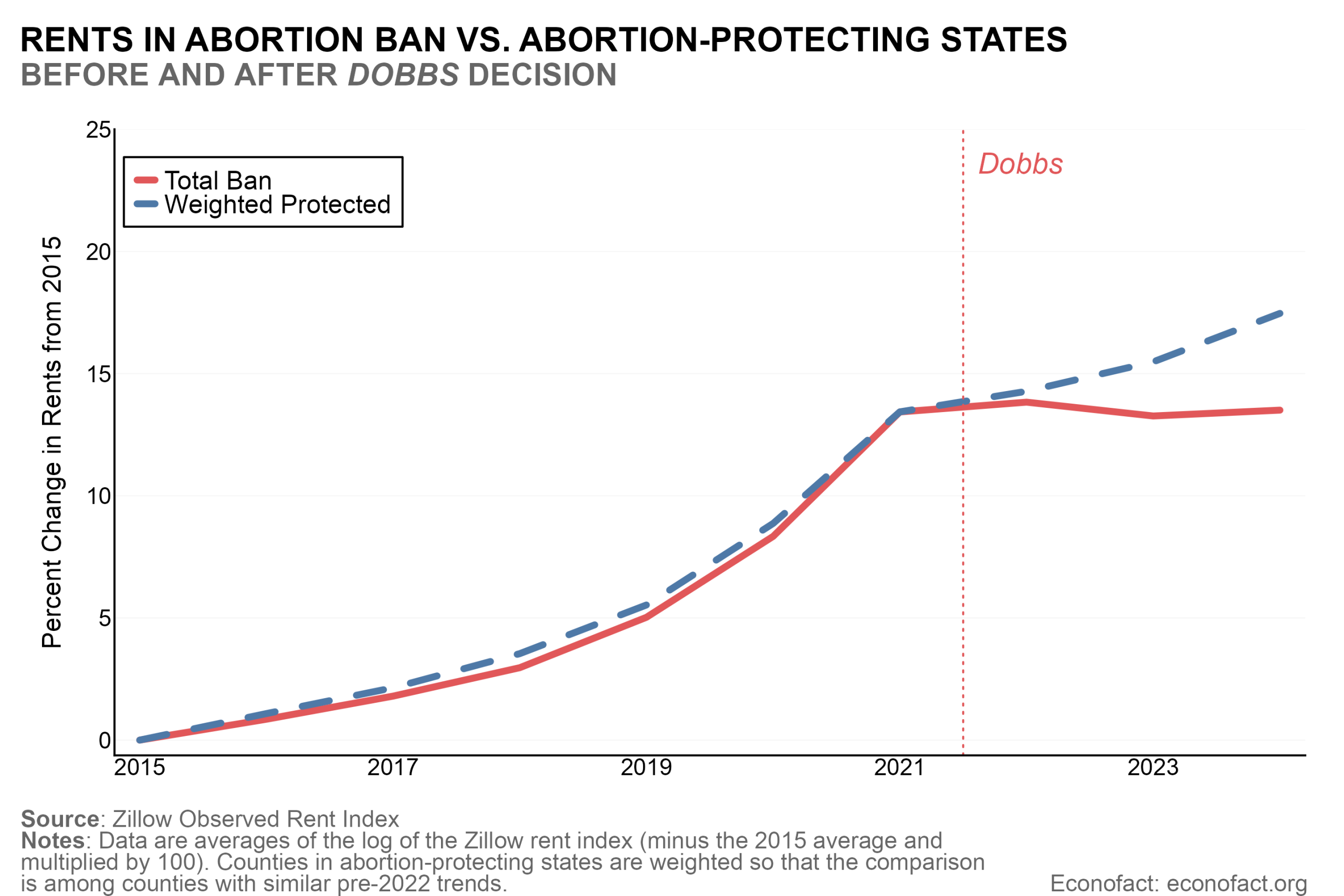
The June 24, 2022 Supreme Court Dobbs decision fundamentally changed the landscape for abortion access across the United States when it overturned Roe v. Wade and ended nearly fifty years of federal protections for abortion. Thirteen states enacted near complete abortion prohibitions in the immediate aftermath or shortly after the Dobbs ruling, while other states maintained or strengthened access to abortion. To the extent that people consider abortion policy as an important characteristic when deciding where to live, these differences could be reflected in housing markets. New research finds evidence of an effect of state abortion bans on local housing markets, with rental price growth stalling and vacancies rising in states that implemented total bans following Dobbs, relative to states protecting or maintaining abortion access.
Total abortion bans reduced rents by an average of 2.2 percent from July 2022 through June 2025.
The Facts:
- The Dobbs decision in June of 2022 resulted in a wide divergence in abortion access and reproductive healthcare between US states. Although the 2022 Supreme Court Dobbs decision was preceded by many state restrictions on abortion, the ruling fundamentally altered abortion access across the United States. The decision allowed thirteen states to implement near-complete abortion prohibitions immediately or shortly after the ruling. These states are Alabama, Arkansas, Idaho, Kentucky, Louisiana, Mississippi, Missouri, Oklahoma, South Dakota, Tennessee, Texas, West Virginia, and Wisconsin. In contrast, twenty-four states and the District of Columbia retained statutory or constitutional protections for abortion or continued to permit abortion up to pre-Dobbs state-defined fetal viability thresholds. A third set of states had intermediate policy regimes in which, for instance, they had trigger bans that were enjoined; or enacted gestational age limits on abortion; or went through rapid legal changes in the post-Dobbs period.
- Existing research suggests that differences in abortion access can contribute to diverging outcomes for women, infants, and families across locations. Previous studies have found that abortion restrictions can have broader impacts that go beyond their direct effect on pregnancy outcomes, such as negative impacts on educational and financial outcomes for women, and higher rates of financially motivated crime. Researchers have begun to study whether changes in abortion policy are contributing to diverging outcomes across states after the Dobbs ruling. For instance, we found a change in moving trends, with population outflows from states with abortion bans increasing over and above what comparable abortion-protecting states experience: states implementing total abortion bans lost approximately 4.9 people per 10,000 residents each quarter in the year following Dobbs, with effects particularly pronounced among single-person households and younger adults. Similarly, the proportion of high-achieving women who applied to a school in one of the 13 states with a total abortion ban decreased after Dobbs, according to one study.
- Beyond the direct impacts on reproductive healthcare access, abortion policy differences between states may affect the broader attractiveness of locations — including how people value living in states with bans versus states that protect abortion access. Housing markets provide a window into people’s preferences for place-based characteristics: when a location becomes less desirable, we expect to see falling prices and rising vacancy rates as demand shifts. Researchers have used housing values and rents to study how people value a wide range of location-specific advantages, such as natural beauty, climate and transportation infrastructure, and disadvantages —including pollution, crime, noise and proximity to power plants.
- Before the Dobbs decision, housing market trends in ban states and abortion-protecting states moved largely in parallel, even during the COVID-19 pandemic. We compare real estate market trends in states that enacted abortion bans to real estate markets in locations that protected or strengthened abortion access before and after the Dobbs ruling. Rental prices, home values, and vacancy rates in both sets of states tracked similar patterns through 2021 and early 2022. This parallel movement provides a baseline for identifying the effects of abortion bans: the analysis attributes post-Dobbs divergences to abortion bans under the assumption that, absent the bans, housing outcomes in total-ban states would have continued to follow the same trend as this weighted comparison group. The analysis uses Zillow's rental and home value indices at the county level, adjusted for inflation. Vacancy rates come from the Census Bureau's Housing Vacancy Survey for major metropolitan areas. To align with the timing of the Dobbs decision and reduce short-term volatility, outcomes are measured as twelve-month averages from July through June of each year.
- Following the Dobbs decision, rental markets in ban states began diverging from those in abortion-protecting states. After the Dobbs ruling, rental price increases in ban states stalled while they continued growing in comparison states. The divergence in rents after Dobbs is most clearly seen when you compare the markets in both sets of states that had the most similar trends prior to the 2022 decision (see chart). At the same time, rental vacancy rates rose more rapidly in ban states than in comparison states. The combination of reduced rents and increased vacancies (relative to comparison states) suggests a demand-driven response to the bans which put downward pressure on prices and left more units empty. These patterns became more pronounced over time.
- To determine whether abortion bans caused the divergent trends in rental markets we use a statistical approach that compares changes in housing outcomes in counties and metro areas in ban states to a set of areas in comparison states selected to best match pre-Dobbs trends. This method accounts for factors that differ between areas in ban states and comparison states and focuses specifically on how outcomes changed after the policy shift. We find that total abortion bans reduced rents by an average of 2.2 percent from July 2022 through June 2025, with effects reaching to 4.0 percent in the most recent year of data. The magnitude of these effects is comparable to findings on the rent effects of substantial changes in air quality or noise pollution. Over the same horizon, bans increased vacancy rates in total ban markets by an average of 1.1 percentage points, with the effect reaching 1.8 percentage points in the most recent year — a substantial change given that rental vacancy rates typically range between 5-7 percent. Effects on home values and homeowner vacancy rates appear smaller and less precisely estimated than effects on rental markets, though they point in the same direction.. The more immediate and pronounced effects in rental markets make economic sense: renters face lower transaction costs and can respond more quickly to policy changes than homeowners, who must navigate the complexities of buying and selling property. Our findings hold after taking into account shifts in housing supply.
What this Means:
These housing market effects are consistent with earlier evidence showing that abortion bans triggered population outflows from ban states and, taken together, suggest that reproductive rights policies can have an effect on the economic value of location. When states restrict abortion access, they effectively reduce the attractiveness of living there for many households — and this change in perceived amenity value shows up in measurable declines in rents and increases in vacancies. These effects are particularly clear in rental markets, where people can respond more quickly to policy changes. For many people, especially younger adults who are more mobile and more likely to support abortion access, state abortion laws have become a meaningful factor in deciding where to live. As the post-Dobbs landscape continues to evolve, policymakers and economic development officials in states with abortion restrictions may need to consider how these policies affect their competitiveness in attracting and retaining residents, and the broader impacts on their communities from housing markets to economic growth.
Editor's note: The analysis in this memo is based on the paper "The Market Value of Reproductive Rights: Evidence from U.S. Housing Markets" by Daniel Dench, Kelly Lifchez, Jason Lindo, and Jancy Ling Liu National Bureau of Economic Research NBER Working paper 34921, March 2026.
Like what you’re reading? Subscribe to EconoFact Premium for exclusive additional content, and invitations to Q&A’s with leading economists.