
Are Tariffs Raising U.S. Retail Prices? (UPDATED)
Harvard Business School
The Issue:
Tariffs on imported goods have risen steeply since President Trump’s second inauguration to the highest level since 1935. New research and constantly updated data of online pricing trends at five major U.S. retailers provide a window into how goods prices are changing in real time in response to tariffs. The emerging evidence from this data shows that prices began rising immediately after the broader tariff measures were announced in early March and continued to increase gradually over subsequent months. The increase in goods prices remains modest relative to the announced tariff rates. But tariff-induced price increases were large enough to have a measurable impact on inflation. We estimate that pass-through from tariffs to goods prices had a cumulative contribution of 0.7 percentage points to the all-items Consumer Price Index by September 2025, such that the annual inflation rate in the all-items CPI —which stood at 2.9 percent in August 2025 — would have been about 2.2 percent in the absence of the tariffs.
The increase in goods prices remains modest relative to the announced tariff rates, but has contributed to inflation.
The Facts:
- The extent to which a tariff increase is reflected in consumer prices depends in part on how the burden of the tax is distributed between foreign producers, domestic businesses and consumers. Tariffs are taxes paid to the federal government by the importer of a foreign good when the good crosses the border. Although tariffs are paid by the business that makes the purchase abroad, who ultimately bears the cost can vary depending on the characteristics of the market for each imported good. In some cases, foreign producers could absorb a portion of the cost if they lower prices in order to continue having access to the U.S. market. Domestic retailers or businesses that use the foreign goods as inputs could also absorb some of the additional cost in the form of reduced profits. The tariff cost can also pass-through to consumers in the form of higher prices. Ultimately, how much of the tariff is passed through to consumer prices and how long it takes for this to happen is an empirical question.
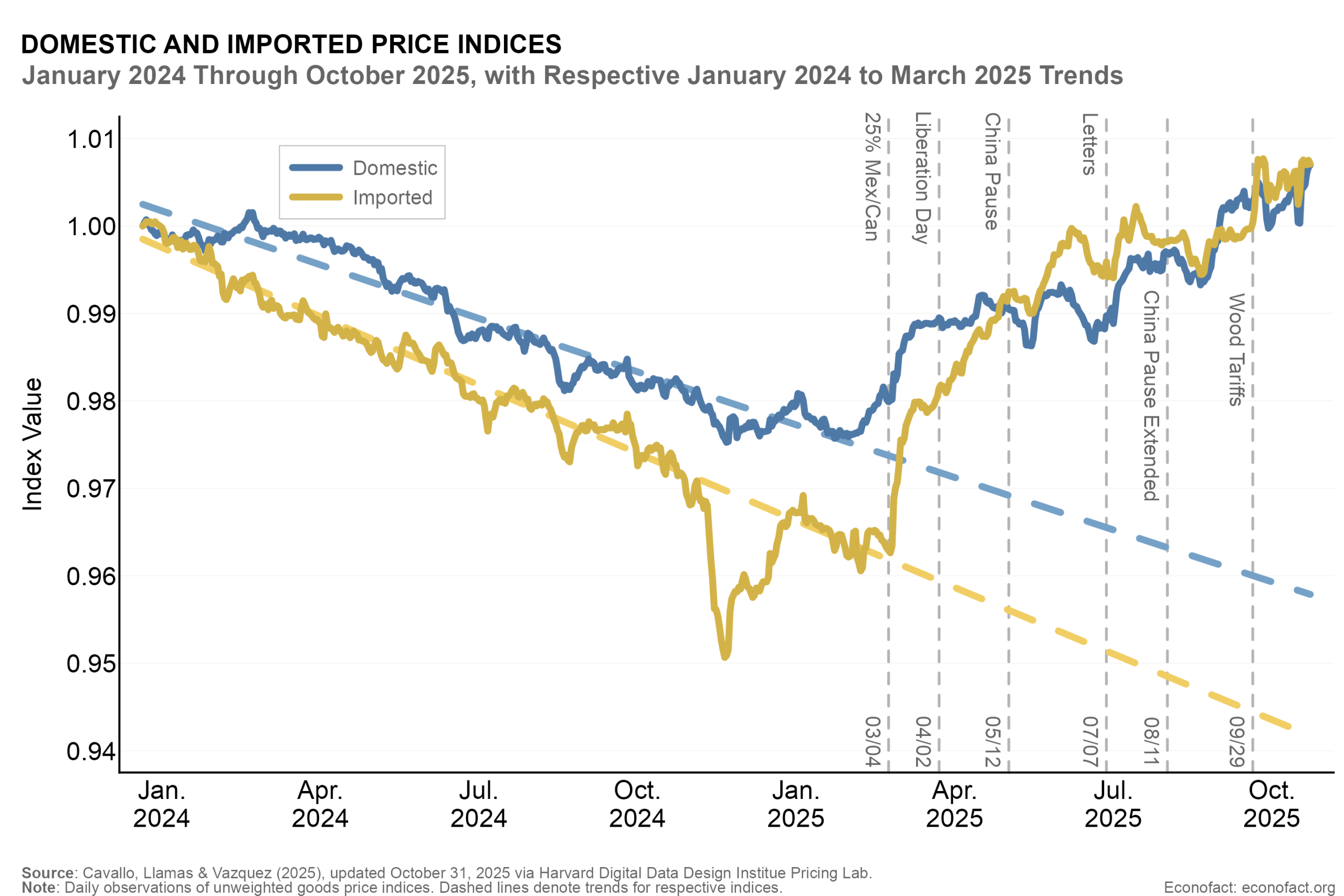
- Prices of both imported products and domestically-produced goods rose in response to tariff announcements. Determining the extent to which tariff increases are translating to higher consumer prices is difficult in the short run. Official price statistics and traditional surveys typically provide data infrequently and with significant lags. To address this information gap, we track daily changes to the online prices of over 350,000 products sold at five large U.S. retailers. In the months before tariffs were implemented, prices for both imported and domestic goods were trending down, reflecting the fact that many goods in our dataset, particularly electronics and furniture, are introduced at high prices and discounted gradually over time (see chart). Prices for imported goods fell temporarily from late November to early January, displaying typical holiday discounts in categories such as electronics and household items. After the tariffs were implemented, prices persistently followed a new upward trajectory, marking a clear break from pre-tariff trends. Retail prices reacted quickly to tariff announcements, rising within days of the first announcements in early March. The adjustment was gradual with prices continuing to increase over the following months. Between March and September, prices of imported goods increased by about 5.4 percent while domestic goods rose by 3 percent relative to pre-tariff trends.
- What are possible drivers of the change in pricing behavior? The rapid price reactions to tariff announcements suggest that retailers were adjusting prices in anticipation of higher import costs rather than in response to tariffs already paid. Because most retailers sell from existing inventories that entered the country before the new tariffs took effect, it is unlikely that the goods sold within days of the announcements had yet incurred any additional duties. At the same time, the firms didn’t raise the price of goods to cover the full extent of the tariff rate in one swift move but rather implemented a series of gradual and incremental changes. Heightened uncertainty about the scope and duration of trade measures, together with concerns about consumer backlash, could have discouraged firms from making full price adjustments.
- There are several possible reasons why the prices of domestically-produced goods also saw milder but sustained price increases since March. For instance, many U.S.-made products rely on imported components, packaging, or raw materials that come from tariffed countries. Firms may raise prices to reflect rising input costs. In addition, producers and sellers of domestic goods may raise prices in response to reduced competition from foreign goods, particularly in categories where domestic and imported products are close substitutes. Indeed, we observed that the prices of domestic goods most affected by import competition rose initially by almost as much as the prices of imported goods, while the prices of domestic goods less exposed to import competition remained more stable. The fact that domestic goods in unaffected categories also rose, albeit by a smaller rate, could indicate that retailers might have raised the prices in these categories to “spread the pain” on consumers, protect their margins amid growing uncertainty, or to preserve relative pricing structures across different product categories.
- The rate of price increases varied significantly depending on the country of origin of imported goods. Among the United States’ main trading partners, we find that imported goods from China experienced larger and more persistent price increases followed by goods from Canada. The prices on imports from Mexico remained largely stable. These different outcomes likely reflect both differences in the tariffs applied to individual countries as well as different expectations about bilateral trade relations. China faced the highest statutory and applied tariff rates, with an average applied rate of 38 percent by July and few exemptions. In contrast, an important share of goods covered in the U.S.-Mexico-Canada (USMCA) trade agreement were exempt from tariffs, resulting in applied rates of only 3 percent on Canadian goods and 5 percent on Mexican goods in our sample. The sharper price response for Canada relative to Mexico may reflect differences in expectations: Canada initially announced retaliatory measures, heightening perceived trade tensions, whereas Mexico maintained a more conciliatory stance. Goods from other countries, including Turkey, Poland, the United Kingdom and Japan saw among the largest price increases. However, because China accounts for over a third of all the products in the sample studied, Chinese imports drive much of the overall increase in import prices that we observe. Among the different categories of goods, the largest price impacts were concentrated in “Furnishings and household goods”, which include many Chinese-made products.
- Within product categories, cheaper varieties saw the highest increases in prices. The prices of the cheapest product varieties rose at an average of 5% between October 2024 and September 2025, about double the rate of inflation of premium products in our sample which rose about 2.5%. This divergence is likely due to the fact that less expensive products tend to have small margins. Retailers have smaller scope to absorb the tariff shock by reducing their margin and thus wind up passing more of the increased cost to the consumer. As low-income households are more likely to buy these cheaper goods, this finding means that low-income households likely experience relatively higher-cost of living increases as a result of the tariffs.
- Our observed average price increases — at 5.4% for imported goods and 3% for domestic goods — are moderate relative to the size of announced tariff rates, particularly on Chinese products. We find that roughly 14 to 20 percent of the tariff changes were reflected in retail prices within six months. These rates are higher and materialize faster than those observed during the 2018–2019 U.S.–China trade war, but remain well below full pass-through, reflecting gradual transmission and continuing uncertainty about policy persistence. Our past research pointed to a range of short-run retailer adjustment mechanisms that are also likely taking place today, such as margin reductions, front-loading of inventories before tariffs became effective and shifting the sources of imports to circumvent tariffs.
- Despite incomplete pass-through, the estimated impact on inflation is significant. To determine the contribution of tariff-related price increases to the overall measure for inflation for the U.S. economy, we combine the observed price changes with official Consumer Price Index (CPI) expenditure weights. We estimate that price increases on imported goods alone account for a cumulative 0.45 percentage point increase in the all-items CPI since March. If we include the observed price increases for domestic goods, this raises the estimated contribution of tariffs to inflation to about 0.7 percentage points. This implies that the observed annual CPI inflation rate of 2.9 percent in August 2025 would have been approximately 2.2 percent in the absence of the tariffs, a level closer to the Federal Reserve’s inflation target.
What this Means:
By tracking the online prices of a broad range of products sold at five major U.S. retailers, we are able to observe the response to tariff announcements in both imported and domestic products, highlighting the broad reach trade policy can have. The short-run retail tariff pass-through was quick to begin, with retailers responding rapidly to tariff news. But it was gradual to unfold, as retailers adjusted prices progressively over time. And it was incomplete after six months, with about 20 percent of the tariff changes reflected at the consumer level. Despite the incomplete pass-through of tariffs, their contribution to inflation over the course of six months was economically meaningful. Given the uncertainty surrounding the tariff announcements, our results suggest pass-through may continue to accumulate gradually over time, putting persistent upward pressure on inflation statistics.
Like what you’re reading? Subscribe to EconoFact Premium for exclusive additional content, and invitations to Q&A’s with leading economists.