
Why Is SNAP Enrollment Falling So Fast?
McCourt School of Public Policy, Georgetown University
The Issue:
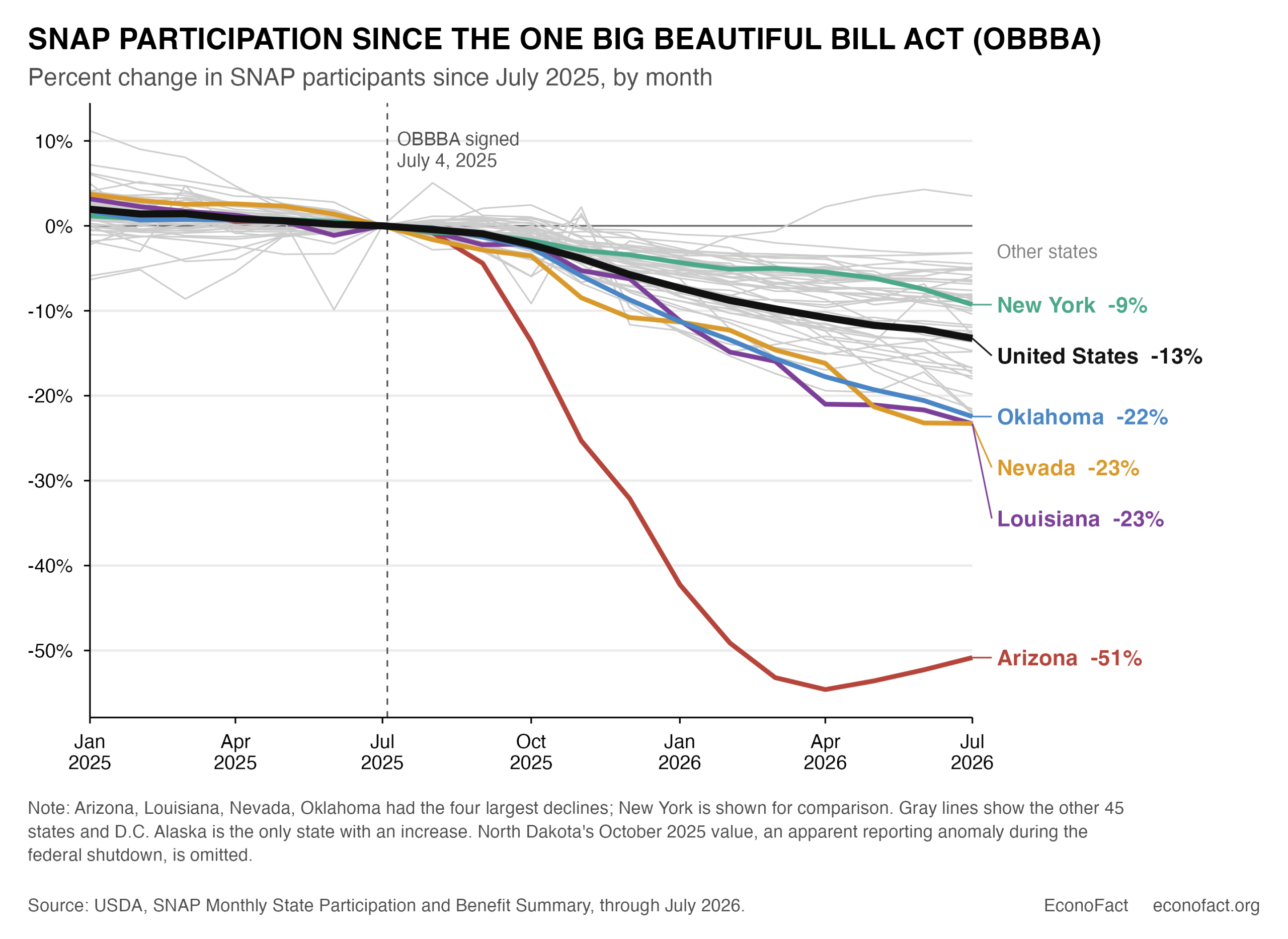
In the year after the One Big Beautiful Bill Act (OBBBA) became law in July 2025, the number of people receiving Supplemental Nutrition Assistance Program (SNAP) benefits fell by 5.5 million, or 13 percent, to 36.1 million. This is the lowest level of participation in SNAP since 2009. While SNAP participation rises and falls with the unemployment rate, the economy has not improved enough to explain the unusual drop. Enrollment has fallen much faster than the Congressional Budget Office projected when the law passed, and the size of the decline has varied widely across states. In Arizona, roughly half of participants have left the program. In New York the decline was under 10 percent. Part of the decline follows directly from the law’s new eligibility rules expanding work requirements. But much of it seems to come from something else: states responding to new administrative demands and new financial penalties. Because SNAP is the country’s main defense against food insecurity, these losses are likely to cause harm. Unfortunately, these changes to SNAP have come just as the federal government has stopped collecting data on food insecurity making it difficult to assess the impact of the SNAP enrollment drop on American families.
Losing SNAP benefits is likely to raise food insecurity for many families, but we will have a harder time measuring it.
The Facts:
- Since the passage of OBBBA, SNAP enrollment has fallen further and faster than projected, but with wide variation across the states. There were 5.5 million fewer individuals participating in SNAP in July 2026 than in July 2025. The Congressional Budget Office (CBO) had estimated that the effects of the different components of OBBBA would reduce SNAP participation and benefits over time. But, by July 2026, enrollment had already fallen to roughly the level CBO had projected for 2031. While SNAP participation tends to track economic conditions and the unemployment rate, labor-market conditions did not improve over this period enough to explain the large decline in SNAP: the unemployment rate has been relatively stable hovering around 4.1 percent. SNAP participation fell in every state except Alaska. The size of the drops varied widely: over 50 percent in Arizona, about 20 percent in Texas and 22 percent in Florida, compared with 7 percent in California and 9 percent in New York (see chart). Differences across states likely reflect timing (some states had extra time to enforce some of OBBBA’s provisions), administrative capacity, and the local characteristics of the population enrolled.
- The Supplemental Nutrition Assistance Program (SNAP) provides benefits that help low-income individuals and families afford the food that they need. Formerly known as food stamps, the program is administered by the states but benefits have historically been fully funded by the federal government. SNAP serves a large and diverse caseload, including low-income working families with children, elderly and disabled people, and very low-income individuals with substantial barriers to employment. In 2025, SNAP served an average of 42.1 million participants per month. Federal SNAP spending totaled $101.7 billion and benefits averaged $188 per participant per month. Eligibility for the program and benefits are determined by income, expenses, family size and other characteristics. Over time the program has increasingly incorporated work requirements. Before OBBBA passed, able bodied adults aged 18-54 without dependents had to work or participate in a work/training program for at least 80 hours a month in order to receive SNAP for more than 3 months out of a 3-year period. There is consistent evidence that the program leads to short- and long-term benefits. Receiving this nutrition assistance reduces food insecurity, improves birth-weights and health among infants, and delivers benefits that persist into adulthood (see here).
- Changes in eligibility criteria introduced by the 2025 reconciliation law were expected to reduce SNAP enrollment. The One Big Beautiful Bill Act narrowed eligibility for SNAP, mainly through expanded work requirements. OBBBA extended SNAP's time limit to adults ages 55–64, to parents whose youngest child is 14 or older, and to veterans, people experiencing homelessness, and young adults who aged out of foster care. People in these groups lose benefits after three months in a three-year period unless they document 80 hours a month of work or a qualifying activity, or obtain an exemption. The CBO estimated that the expanded work requirements would have the effect of reducing participation by 2.4 million participants in an average month over 2025–2034. Separately, refugees, asylees, and some other lawfully present immigrants who previously were eligible for SNAP benefits lost eligibility as a result of OBBBA; the CBO estimated that this provision would result in about 90,000 fewer people enrolled in an average month.
- The new eligibility rules don't account for the full decline. Families with children are largely outside the new work requirements, yet an estimated 2 million fewer children received SNAP in October 2026 than in July 2025. This likely reflects some combination of eligible households lost at renewal over paperwork, fewer new applicants, and immigrant families staying away for fear of immigration enforcement, including members who remain eligible. Currently available data don't yet allow us to separate these channels.
- Under OBBBA, states will potentially have to pay for a share of SNAP benefits, in the order of hundreds of millions of dollars. Starting in October 2027, states will for the first time pay part of SNAP benefit costs: 5, 10, or 15 percent, depending on their payment error rate, a measure that counts overpayments and underpayments to people who receive benefits. Small differences in the error rate have significant fiscal consequences for states. For instance, based on a 6.86 error rate in 2025, New Jersey would have to pay 5 percent of program costs in 2028 amounting to about $100 million, according to estimates from the Center on Budget and Policy Priorities. With an error rate under 6 percent, the state would not have to pay any program costs.
- The new financial penalties give states strong incentives to tighten verification. The payment error rate does not count eligible people who are wrongly denied or cut off. As a result, under the new rules, closing a case is fiscally safer for a state than paying a household whose file might contain an error. State error rates are also estimated from small samples. For a typical state, the 95 percent confidence interval is about 4.4 percentage points wide, which is wider than the 2-point bands that set a state's cost share. A state therefore cannot reliably control which band it lands in, which may push it to overshoot (see here). At the same time, OBBBA made it harder for states to invest the resources needed to reduce errors by cutting in half (from 50 percent to 25 percent) the share of state SNAP administrative costs that the federal government covers and eliminating some program simplifications, making eligibility and benefit determinations more complex, despite the fact that greater complexity tends to result in more errors.
- Arizona shows how state responses can multiply the law's effects. Arizona moved earliest and most aggressively to cut its error rate, and its caseload fell by about half between July 2025 and July 2026, the steepest drop in the country. Beginning in fall 2025, the state stopped accepting applicants’ own statements about household size, utility costs, and medical expenses. At the same time, the number of state staff determining eligibility fell from 1,370 in July 2024 to 880 a year later. Applicants described phone lines that wouldn't connect, being informed of interview appointments after they were scheduled to occur, and cases closed over a single wrong document (listen here). The state’s SNAP director acknowledged that some of the roughly 400,000 people who left the program were probably still eligible, though he could not say how many. The state says that added staff and online document upload have since stabilized its caseload.
- Losing SNAP benefits is likely to raise food insecurity for many families, but we will have a harder time measuring it. Research finds that SNAP reduces food insecurity by about one-fifth among participating households and by about one-third among children (see here and here). Adults who lose SNAP because of work requirements take on more credit card debt and fall behind on payments more often. While food banks cannot replace a program of SNAP’s magnitude, they are seeing the effects of the SNAP decline. In October, 2026, nearly three-quarters of the country’s largest food banks reported more visitors than in the prior year. However, the U.S. Department of Agriculture (USDA) has stopped the annual Food Security Survey, the only national source that tracks food insecurity consistently over time, making it difficult to measure the impact of SNAP policy changes.
- The U.S. Department of Agriculture recently announced its intention to further reduce SNAP eligibility for additional families. On November 10, USDA published a proposed rule on the federal register that would limit Broad-Based Categorical Eligibility (BBCE) for SNAP. BBCE allows states to provide SNAP benefits to some families that exceed the federal gross income test (130% of poverty) and asset test threshold for the SNAP program. SNAP participants under BBCE still have to pass the other (net) income test and go through the normal application process. Families eligible under this provision tend to be low-income working households, or households with elderly or disabled members, with high housing or childcare costs. In its notice, the USDA acknowledged that these revisions could increase the administrative burden on states, reduce SNAP benefit spending, and reduce school meals eligibility. The USDA estimates that if this rule is implemented, about 3.2 million households containing 6.3 million individuals would lose SNAP benefits in 2029, the first year the proposed rule would reach its full effects.
What this Means:
The changes to SNAP introduced by the 2025 reconciliation law were expected to result in deep cuts to the program. But the fall in SNAP participation in the year since the act’s passage has been much faster and deeper than anticipated. The drop in SNAP enrollment likely reflects the new federal eligibility rules, plus state administrative responses that appear to be screening out many people who remain eligible. States face strong incentives to deny or close cases rather than risk payment errors. Those incentives will likely grow as the October 2027 cost-share start date approaches, when states are slated to begin paying a share of annual SNAP costs as determined by their error rate. Better information is needed to determine what share of people who continue to qualify for SNAP benefits are nonetheless dropping out of SNAP rolls. States should be reporting why people leave SNAP, including how many lose eligibility under the new rules, and how many leave for procedural reasons such as missed interviews or missing paperwork. Further reductions in SNAP enrollment are to be expected if the recently proposed changes to Broad-Based Categorical eligibility are implemented. In the face of these dramatic reductions in SNAP participation, it becomes even more important to restore the collection of national food insecurity data so that policymakers can assess whether the shrinking caseload means more families are going without enough to eat. Finally, the cost-share formula ties large fiscal penalties to imprecise error-rate estimates. Unless that changes, states will keep facing pressure to shrink the program even when need is rising.
Like what you’re reading? Subscribe to EconoFact Premium for exclusive additional content, and invitations to Q&A’s with leading economists.