
Do State Abortion Bans Raise Women’s Medical Out-Of-Pocket Expenditures?
University of Michigan
The Issue:
After the 2022 Dobbs decision eliminating the federal constitutional right to abortion, many states restricted access to abortion including total bans and early gestational limits between 6 and 12 weeks. Research has found that the bans are associated with increases in births and birth complications, both of which are associated with substantial costs to payers and may be borne by individuals and passed on to beneficiaries by insurers through increased premiums. The bans also have the potential to affect demand for health insurance, in order to obtain long-acting reversible contraception to decrease the risk of an unplanned birth, and the risk of catastrophic expenses associated with an unplanned birth or birth-related complications. New research provides the first evidence that the introduction of abortion bans has had a significant impact on the share of women paying for health insurance premiums and enrolling in private health insurance plans.
New evidence suggests that the introduction of abortion bans affected the share of women paying for health insurance premiums and enrolling in private health insurance plans.
The Facts:
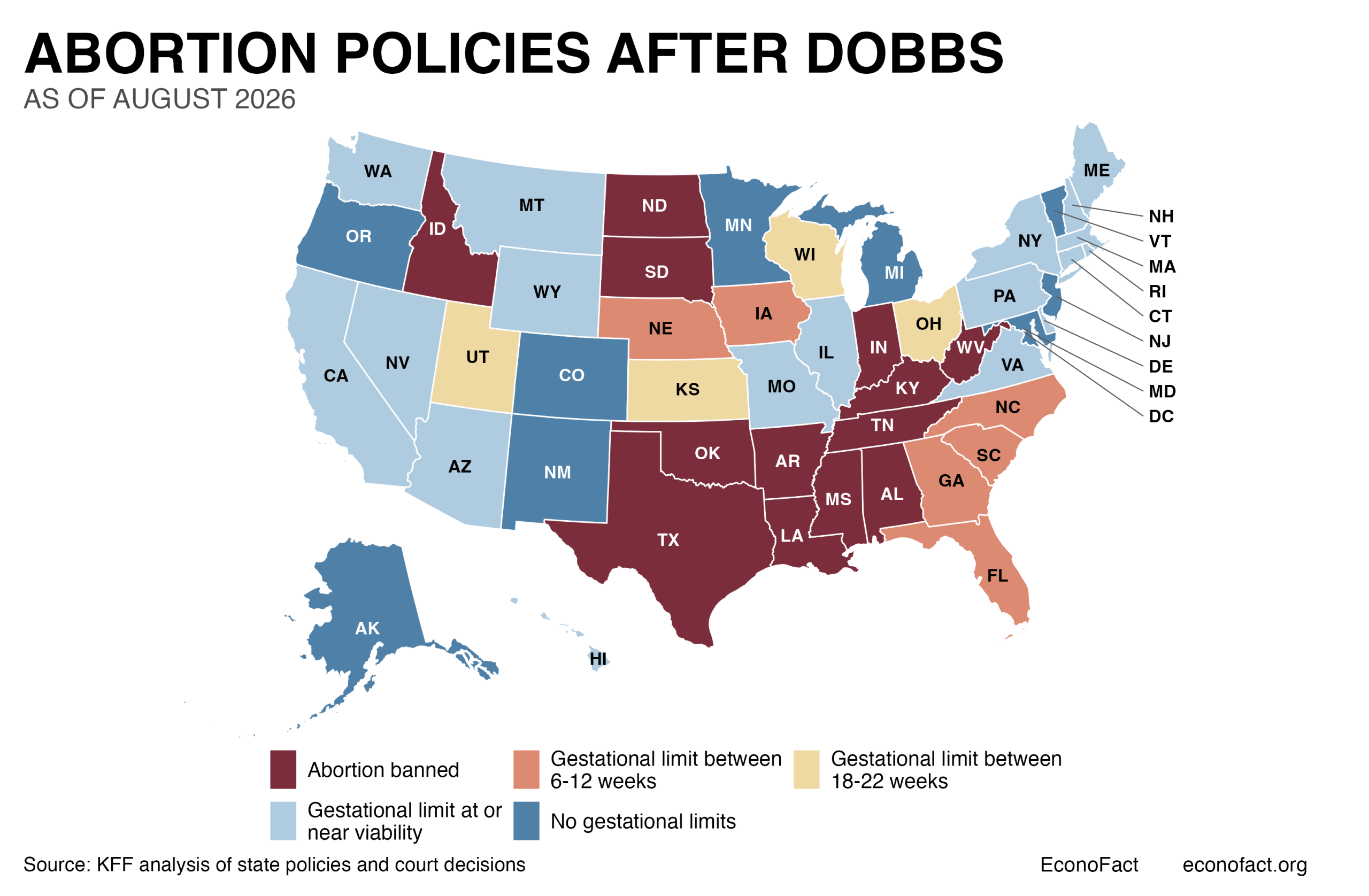
- Differences in abortion access across the states increased following the Dobbs decision. On June 24, 2022, the U.S. Supreme Court returned the authority to regulate or ban abortion to the elected branches and individual states when it overturned Roe v. Wade and Planned Parenthood v. Casey with its decision in Dobbs v. Jackson. The ruling resulted in substantial state variation in access to abortion. Several states had laws in place that would trigger abortion bans if Roe were overturned, which became effective immediately or soon after Dobbs was decided in 2022. (One exception was Texas, which had already banned most abortions after 6 weeks in 2021 and then banned all abortions in August, 2022 after the Dobbs decision). Other states moved towards greater protections for abortion access, while some implemented abortion restrictions based on gestational age. As of 2026, abortion was banned in 13 states, 6 states had abortion restrictions between 6 and 12 weeks of gestation, 4 had gestational limits at 18-22 weeks, and the remaining 27 states and the District of Columbia had either no restrictions or allowed abortions at or near the point when the fetus can survive outside the womb (see map).
- A growing body of research finds evidence that differences in abortion access translate to differences in maternal and infant health outcomes across states. States that banned abortion following Dobbs experienced a 2.3 percent increase in births on average above what would have been expected in the absence of a ban, according to one study. Increases in fertility rates in ban states were largest among women who had lower levels of education, lower incomes and were less likely to be married (see here). Differences in abortion access also have the potential to impact the clinical care available to women, even for conditions unrelated to elective abortion. Four in 10 OBGYN practices in ban states reported that they had felt constraints on their ability to provide care for miscarriages and other pregnancy-related medical emergencies since Dobbs. For instance, there was a shift in the management of spontaneous abortions away from medication toward waiting for miscarriage resolution in states that banned abortion after Dobbs, as well as a shift to misoprostol-only regimens for those receiving medication over the evidence-based mifepristone plus misoprostol combination. Studies have found differences in maternal and child morbidity associated with abortion bans. Texas’ total abortion ban was associated with an increase in severe morbidity in cases of pregnancy loss as measured by a 15 percent increase in blood transfusions over what would have been expected prior to the ban. States with restrictive abortion policies after Dobbs have seen an increase in the birth rate of infants with a type of congenital heart disease, diverging from the trends observed in states with greater abortion access.
- To the extent that abortion bans lead to increased birth rates and care complications, these could result in higher medical expenses. In the United States, the costs of medical care are borne by many parties across the healthcare system and the distribution of those costs is determined by the patient’s insurance coverage. Patients who qualify for Medicaid, for instance, generally do not pay out-of-pocket costs for health insurance premiums or non-premium out-of-pocket medical expenses, with the cost of care covered by Medicaid, funded by federal and state governments. Uninsured patients bear the full cost of their care, with unpaid expenses needing to be written off by health care providers. Patients insured by private health insurance coverage pay for health insurance premiums (some of which may be covered by employers or paid by spouses or parents) and bear some portion of their cost of care, with their insurers paying the residual.
- Did abortion bans lead to changes in medical out-of-pocket spending? If abortion bans lead to more births or care complications we could see increased medical out-of-pocket spending by individuals associated with this care. We could also see increased spending on insurance premiums to the extent that individuals take up private insurance or switch to more expensive plans to better protect themselves, or that insurers pass these costs onto beneficiaries. To determine whether abortion bans affect individual medical spending, we analyze how medical out-of-pocket spending changes over time (post-Dobbs versus pre-Dobbs) for each ban state and compare these trends with a set of states (among those protecting or maintaining abortion access) that has been refined to include only those that did not expand Medicaid between 2018 and 2024 and that had the most similar patterns in post-pandemic Medicaid unwinding. We find no difference in the pattern of out-of-pocket medical expenditures between the two groups of states in the years leading up to Dobbs. However, immediately following the Dobbs decision there is a statistically significant increase in the share of women paying for premiums in abortion ban states over and above what abortion-protecting comparison states experience. We do not see a statistically significant effect on non-premium expenditures for women, nor do we see significant effects on the share of men reporting premium payments or non-premium expenditures.
- Results show very different effects and mechanisms by income level, consistent with access to health insurance based on income eligibility. For women with household income below 138 percent of the Federal Poverty Level (FPL), who generally have access to Medicaid, we do not find significant differences in the share paying medical insurance premiums between abortion ban states and similar states that had abortion access in place. In contrast, for women with household income between 138% and 250% of the FPL who are generally not income-eligible for Medicaid, but may be eligible for maternity Medicaid, we see a 5.1 percentage-point decrease in the likelihood of having no premium expenditures in states with abortion bans after Dobbs. In addition, we see a 5.0 percentage point increase in the likelihood of having policyholder employer coverage for these women in states with abortion bans. For women with household income above 250 percent of the FPL, we also see a 2 percentage-point decrease in the likelihood of having zero premium expenditures, but we do not see significant effects on any type of health insurance coverage. The effect on premium expenditures with no corresponding increase in health insurance coverage suggests that they are bearing more of the costs of coverage associated with their private insurance. This outcome could reflect women shifting to more comprehensive and expensive coverage or higher premiums associated with the same plans. Since women with household income above 250 percent of the FPL make up the largest share of our sample, we identify the second mechanism, of women bearing more of the premium costs associated with their private insurance, as the dominant effect of abortion bans on premium expenditures.
What this Means:
The results of our research suggest that the effects of abortion bans go beyond the direct impact on people who would seek an abortion. Our results suggest that abortion bans are associated with more women paying premium expenditures through two mechanisms. First, they suggest that more women are taking up private insurance, evident for women with household income just above the threshold to qualify for Medicaid. Second, they suggest that women at higher levels of income are bearing more of the costs of their private insurance, which could reflect a shift to more comprehensive and expensive plans or could reflect higher premiums associated with the same plans. These findings are consistent with the mechanism that an increase in births, and risky births in particular, would increase costs for payers, including insurers and employers. Then, insurers and employers pass these costs onto beneficiaries, and we see increased out-of-pocket insurance premium expenditures. Our results quantify how medical spending for one payer in the larger U.S. healthcare system, individuals, was affected by post-Dobbs abortion bans. As the post-Dobbs legal landscape continues to evolve, it is important for policymakers to consider how abortion bans affect payers across the larger U.S. healthcare system, including private insurers and Medicaid, employers, and providers, as well as individuals.
Like what you’re reading? Subscribe to EconoFact Premium for exclusive additional content, and invitations to Q&A’s with leading economists.