
Data Centers: Benefits vs Costs and Risks
EconoFact
The Issue:
The dramatic recent surge in investment in data centers in the United States is boosting the economy but at the same time sparking heated opposition. The stark tensions reflect very different viewpoints on the benefits vs the costs and risks of data centers. For their supporters, data centers are providing the infrastructure backbone for the adoption of Artificial Intelligence (AI) with a potentially transformative long-term impact on the US economy, well beyond the already significant short-term stimulus to growth. However, critics have raised a wide range of concerns: that the data center boom and the required massive debt financing needed to sustain it could end in a damaging bust; that the promised local benefits of data centers in terms of jobs and tax revenues are exaggerated while the spending on data centers is crowding out other types of investment; that data centers can impose heavy energy and environmental costs on local communities; and that the Artificial Intelligence that data centers are empowering will destroy jobs and even threaten humanity itself.
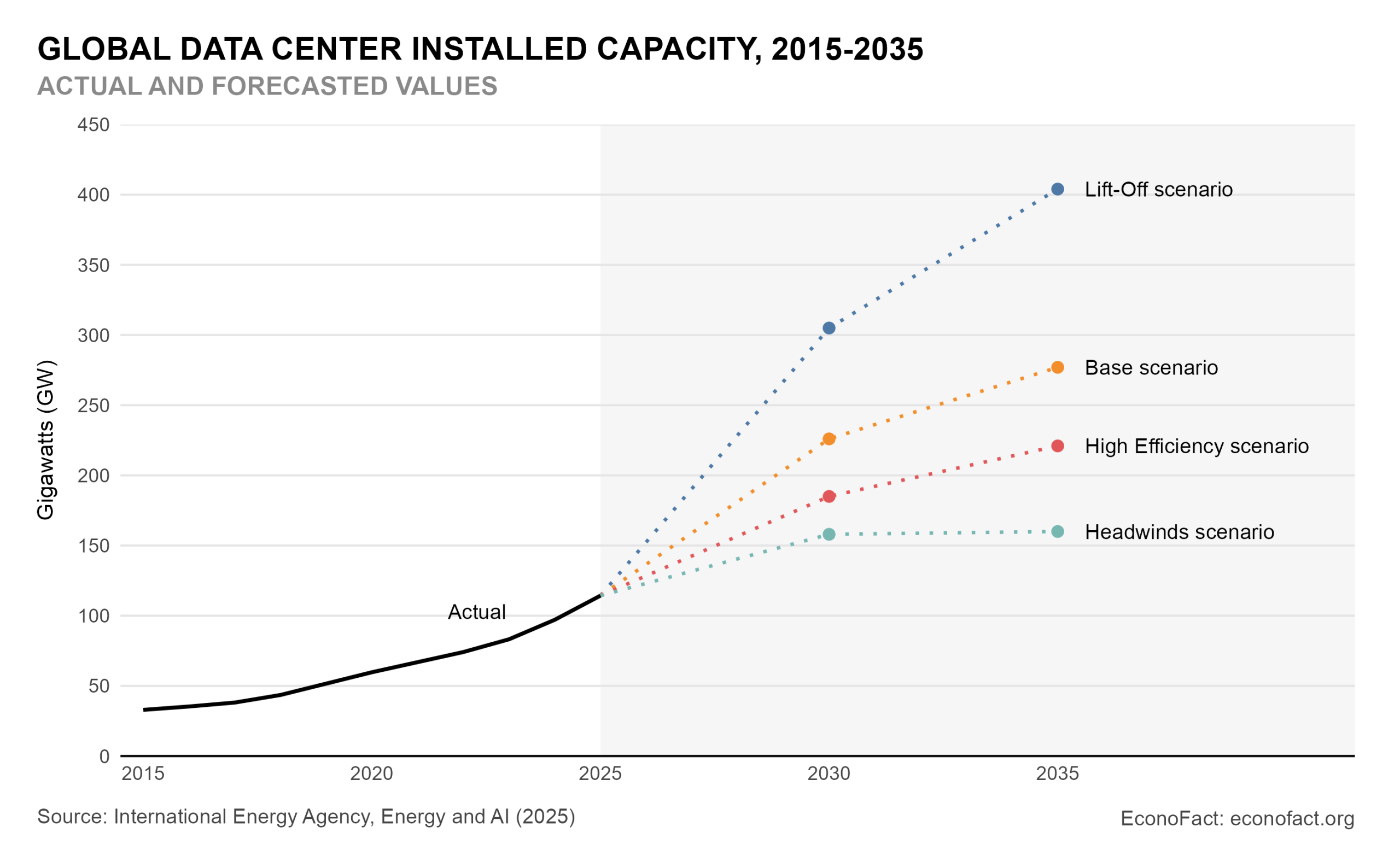
Data center spending is expected to continue at a high level through the end of the decade, although projections vary widely.
The Facts:
- Data centers are industrial facilities that house the servers, storage and networking equipment that run digital services provided remotely over the internet. Data centers have been around at a small scale since the late 1990s as the internet and cloud computing developed. However, global data center capacity has taken off over the past decade, growing three times from 2015 to 2024, mainly in the United States (see chart). This boom has intensified since the launch of Chat GPT in late 2023 and the rapid adoption of artificial intelligence tools by both businesses and households in the US, which has far outpaced the spread of personal computers and the internet in earlier decades.
- The recent surge in capacity has been driven by huge investments by the so-called five hyperscalers: Microsoft, Amazon, Oracle, Meta and Alphabet [Google]. These companies are spending an estimated $800 billion on data centers in 2026 representing about 9 percent of all U.S. capital expenditures. Modern AI-related data centers are often designed at a massive scale, packing together cutting-edge GPU microprocessors with high-speed interconnects in a single location with large electricity and cooling needs. These mega centers are used to train new AI models such as those offered by Open AI and Anthropic and increasingly to support the use of AI (known as “inference”), which Deloitte estimates at around 2/3 of AI computing needs in 2026, up from one third in 2023. While model training could be accomplished offshore in places with cheap and abundant energy — for instance in the Middle East — inference services need to be near centers of population to minimize delays in real time response by AI applications such as AI agents, fraud detection, and self-driving cars. This means that widespread adoption of artificial intelligence in the United States can't just rely on data centers built in remote locations with abundant cheap energy.
- Data center spending is expected to continue at a high level through the end of the decade, although projections vary widely. A report by the International Energy Agency (IEA) provides a baseline scenario with global data center capacity rising from 97 GW in 2025 to 226 GW in 2030, but with three other scenarios ranging from 158 to 305 GW in 2030 (see chart), driven largely by growing AI computing needs. The wide range of uncertainty arises from unresolved questions about the extent to which AI will be widely adopted by businesses and households; whether AI providers can capture monetary returns from the users commensurate with their costs; how quickly the microchips that account for the lion’s share of data center construction costs are replaced by newer, more powerful and more energy efficient chips; and the political resistance to new data center construction. Estimates from a study focusing on the United States, present a central scenario projecting an increase from 57 GW of data center capacity in 2026 to 240 GW by 2032, at a total cost of around $10 trillion. This would represent 3.5 percent of US GDP over 2025-2032, which would be substantially larger than previous surges in infrastructure spending like railroads in the 19th century (2.2 percent of GDP) and the internet in the 20th century (1.1 percent of GDP) (see here).
- The recent surge in data center spending has provided a short-term boost to the US economy. A Federal Reserve study used simulations of actual projects to estimate that data center spending on plant and equipment (net of imported components) contributed around 0.20 percentage points to the 2.3 percent US GDP growth in 2025 and is contributing 0.40 percentage points in 2026. (See also these similar estimates based on recent GDP data). The US economy has also benefitted indirectly from the run-up in stock prices of the leading companies providing AI services, which increases investors’ wealth (and therefore spending), partially offset by the crowding out of other types of investment through the competition for funding and the associated increase in long- term interest rates. On the employment front, data center construction boosts US jobs for construction workers and in manufacturing electrical equipment, although the post-construction employment impact is small since running and maintaining data centers requires very few people. There could be a negative impact on jobs displaced by increasing use of AI, although such effects so far seem limited. Over the longer horizon, the expanding application of AI services provided by data centers is expected to boost productivity growth, although the scale of the gains are unclear (learning from experience with the IT boom in the 1990s) and need to be weighed against potentially negative effects on employment (especially opportunities for younger workers).
- At the local level, some jurisdictions that have successfully competed to attract data centers have benefitted from a boost to economic activity and tax revenues. Over the period 2000-2025, 38 states introduced tax incentives to attract data centers, typically through exemptions from sales and use taxes subject to at least a minimum level of investment and, in some cases, commitments to create jobs. The same study estimates that these incentives, which could amount to around 11 percent of development costs, were effective in promoting investment in local data centers, which then boosted local taxes (after taking account of tax concessions). In particular jurisdictions, data centers provide a substantial share of the revenue base: Virginia’s Loudon County, for example, raises 40 percent of its revenues from property taxes on data centers. Another study showed broader gains in employment, wages, business establishments and business income for the local economy after activation of a data center, although these spillovers were not uniform but concentrated in metropolitan counties, in early entrants in the data center business, and for facilities operated by one of the Big Tech companies.
- Weighing against such benefits are the costs and risks associated with data center construction. A major concern is that the data center boom may end in a damaging bust if the surge in capacity exceeds the ability of AI providers to raise commensurate revenue from selling AI services. As in previous cycles of infrastructure spending such as railroads and the internet, the lure of gaining a dominant position is spurring massive investment but even with widespread AI adoption some companies will thrive while others fail. Already data center construction is leading to a build-up in leverage as the hyperscalers have turned to bond markets to raise additional funding for their current massive data center spending, while smaller companies and start-ups building data centers to rent (such as the so-called neo-clouds) have had to rely heavily on floating debt using complex and sometimes opaque funding structures. Van Nieuwerburgh estimates that the anticipated data center investment path would need annual revenues from AI charges of $3.7 trillion by 2032 (around 9 percent of projected US GDP) to provide an adequate rate of return. The implied price per billed GPU hour is broadly in line with current frontier GPU rental prices, but questions remain whether demand and pricing power would remain strong enough to sustain such prices once all the additional computing capacity is added, particularly if the AI marketplace becomes more competitive with increasing use of cheaper open-weight models (which have been championed by China) rather than the proprietary models developed by most of the main U.S. AI providers.
- An immediate concern at the local level is that the rapidly growing power needs of data centers threaten to push up electricity prices for other local consumers, undermine grid reliability and increase pollution and greenhouse gas emissions. A University of Georgia study finds that power needed by data centers has already pushed up electricity prices by around 5 percent in areas where the costs of additional capacity are largely borne in a limited local area. This problem is likely to get worse: The International Energy Agency projects that data center electricity consumption is set to double by 2030, accounting for more than half of electricity demand growth in the United States (see here). After twenty years of flat growth in power capacity, the electricity industry and policy makers will have to scramble to fill the now wide gap between current capacity and the projected surge in demand.
- Such concerns have been feeding a popular backlash against data center construction in local communities. A recent Economist/YouGov poll found that 63 percent of Americans opposed construction of a data center in their community. This poll identified specific concerns about the adverse impact of a data center on local electricity rates and on home values. The backlash also probably reflects perceptions that massive data centers are environmental eyesores with limited economic benefits other than in areas well established as tech hubs and a sense that approvals for new data centers are rushed through by developers with limited information to the public and inadequate consideration of local concerns. More broadly, the unpopularity of data center construction may reflect widespread concerns about the potential impact of AI, including on employment, rising wealth disparities, and even as an existential threat to humankind. As a result, many communities have been considering tightening approval requirements and limiting tax benefits for new data center projects. Even Loudon County, Virginia and the state of Texas, which have been among the biggest beneficiaries of data centers, have recently taken steps to tighten approvals for construction of new data centers and permitting for connection to the local electricity grid.
What this Means:
Greater realism about the costs and benefits of data centers is clearly required. While data center construction underpins the rollout of AI that could have a transformative impact on the US economy, a “full speed ahead” laissez faire policy on data center construction runs into serious concerns about the costs and risks involved. Moreover, such an approach is not politically feasible as the pressures on power supply costs have become better appreciated and the limited net benefits for most local community hosts more soberly assessed. Regaining popular support for data centers will depend on a better calibrated approach to meeting burgeoning power needs — ensuring that the costs of the needed increase in capacity fall squarely on the data center operators rather than on local electricity consumers and fostering the required growth of overall electric power capacity. It will also be important to develop partnerships between data center builders and local communities that provide greater transparency about decision-making and optimize local benefits. More broadly, at a national level, steps to ensure that the benefits of the AI rollout are more widely shared and that the costs and financial risks are adequately controlled would help to rebuild public support.
Like what you’re reading? Subscribe to EconoFact Premium for exclusive additional content, and invitations to Q&A’s with leading economists.