
The Long Shadow of Gender Discrimination in Hiring
Federal Reserve Bank of Philadelphia, University of Rochester and Michigan State University
The Issue:
Prior to the 1964 Civil Rights Act, it was both legal and common for employers to express explicit gender preferences in their help wanted ads. These ads offer a window into employers’ potentially discriminatory preferences at a time when such preferences could be openly stated. We measure gender targeting before civil rights using help wanted ads and relate these to firm-level female employment shares over the remainder of the 20th century. Even though explicit gender targeting in job ads eventually faded, we find that employer preferences over worker gender have remarkably persistent effects on female representation at work. When focusing on similar firms hiring for the same occupations and in the same labor markets, those expressing a stronger preference for hiring men before the Civil Rights Act still had significantly higher shares of male workers decades later. Nonetheless, these differences between firms narrowed over time, which is consistent with the impact of policies aimed at reducing discrimination.
Firms that expressed a stronger preference for hiring men before the 1964 Civil Rights Act still had significantly higher shares of male workers in 1995.
The Facts:
- Explicit gender targeting in recruiting was once legal and commonplace. Up to the 1960s, employers freely listed their gender preference in the text of their help wanted ads along with other desired worker attributes. In addition, newspapers commonly organized pages of job ads according to gender: Most pages would include as a header: “Help Wanted: Female,” “Help Wanted: Male”. Firms’ and newspapers’ ability to legally target workers on the basis of gender was progressively constrained by the 1964 Civil Rights Act, the 1965 establishment of the Equal Employment Opportunity Commission, and subsequent legislation and court rulings. Enforcement of these new pieces of legislation gradually and unevenly strengthened throughout the mid-to-late 1960s and early 1970s.
- We analyzed help-wanted ads from three major U.S. newspapers originally published between 1940 and 2000 and a 1958 college placement directory written to help match college students with employers. In the newspapers, we found that 7 percent of ads in the 1940s state an explicit preference for male applicants, while 5 percent target women. These rates gradually decline over subsequent decades, as enforcement of the Civil Rights Act strengthened, but the practice does not fade completely until the mid 1970s. In the 1958 college placement directory, all listings include gender preferences: 72% target only men, 9% target only women, and the remainder are open to both. Jobs requiring men tend to be higher skilled and higher paying.
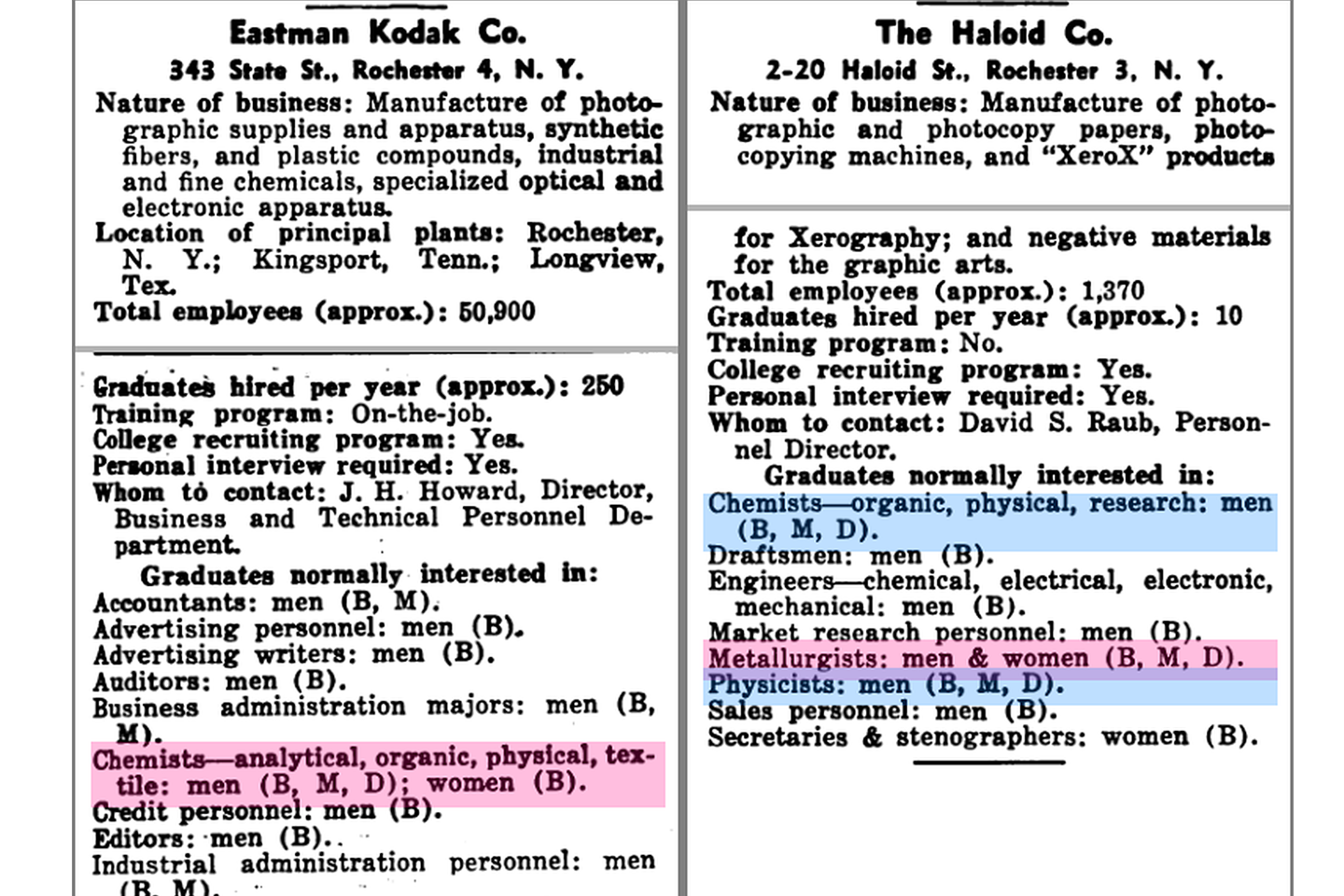
- There is considerable variation across firms in gender targeting beyond what could be predicted from occupational norms. Listing a gender preference in a job ad may reflect social norms or a firm’s expectations of labor availability. For instance, in the 1950s, firms might have been more likely to specify men in their ads for doctors and lawyers since women rarely held advanced degrees. They may have required men for their construction jobs and women for secretarial work because they would not have expected women to apply for construction jobs or men to apply to be secretaries. But we show that there are differences between firms with some expressing stronger preferences for male workers than other firms for similar jobs in the same labor markets. For example, while Eastman Kodak lists a willingness to hire both men and women as chemists in the 1958 college placement directory, the Haloid Company – which would later become Xerox Corporation – listed only men for their chemist positions (see illustration above). Both companies were headquartered in the same labor market (Rochester, NY) and operated in broadly similar industries.
- Firms that show a stronger preference for male workers in their ads tend to employ a larger share of men in those occupations than other firms. We use information on the demographic make-up of establishments, which has been collected by the Equal Employment Opportunity Commission (EEOC) since 1966, as a requirement for large companies under the 1964 Civil Rights Act. We find a strong correlation between male targeting and male employment shares in the 1960s across both vacancy datasets. A firm with a 1 standard deviation higher idiosyncratic targeting rate in a given occupation has a roughly 7 percentage point (10%) higher male employment share in that occupation.
- The relationship between pre-civil rights male targeting and male employment share persists throughout the 20th century. We are able to match pre-civil rights newspaper ads and employment directory listings with 2000 firms that file annual reports on the gender distribution of workers to the EEOC records through 1995 (the latest publicly available data). Decades after the practice of including gender in wanted ads faded, firms that had expressed greater male targeting pre-civil rights still employed a higher share of men for those occupations than similar firms with a lower degree of male targeting.
- Despite this persistence, anti-discrimination policy of the 1960s and early 1970s had an apparent impact. Starting in the mid-1970s we find some convergence in the male employment share between firms with more and less male targeting. This convergence happened during the period in which enforcement of measures to address sex-based discrimination was strengthened. It also occurred alongside many other factors that impacted women at work, for instance the expansion of the birth control pill which allowed for delayed marriage, title IX which greatly expanded women’s access to education opportunities, and a larger social movement that (among other things) increased female labor force participation. In the context of the rapid integration of women to the labor market, it is unlikely that the more discriminatory firms would have been more responsive to changes driven by the social movement compared to firms with an explicit openness for both genders in the pre-civil rights period. The modest convergence that we find is thus consistent with the Civil Rights Act and related anti-discrimination measures having greater impacts on firms that were arguably more likely to be discriminatory and therefore more subject to anti-discrimination legislation, to those that were not. The effects are modest because progress appears to stall beginning in the 1980s. From there we see the remaining correlation between gender preferences and gender representation in employment stays steady through the end of our data period, 1995.
What this Means:
Gender discrimination drove systematic differences in female representation at work through the end of the 20th century – the last publicly available data. We see no evidence that the relationship would die off from there. But, tracking how the gender composition of employment continues to evolve will likely be more difficult in the future. The Equal Employment Opportunity Commission (EEOC) voted to stop collecting data on the demographic make-up of regulated establishments in July, 2026, arguing the reporting requirement is too costly. Our research highlights two important arguments for their continued collection: 1. We (and other researchers before us) have shown how tremendously useful the measurement of representation at work is and 2. We find a direct need to continue to monitor barriers to women’s representation at employers in the modern economy.
Like what you’re reading? Subscribe to EconoFact Premium for exclusive additional content, and invitations to Q&A’s with leading economists.