
Can Child Savings Accounts Help Low-Income Families Build Wealth?
Duke Sanford School of Public Policy
The Issue:
Family wealth plays an important role in creating positive outcomes for children. But building wealth is challenging for many Americans, especially for families in the lowest income brackets whose resources typically are not enough to cover more than their immediate needs. Yet, due to compounding returns, the earlier a family or individual starts setting money aside in a savings or investment account the more resources will be available later in life and the greater the impact it can have. Several child savings and investment accounts that offer a range of financial enticements and tax advantages have been created to promote starting to save early in a child’s life, including the new Trump Accounts for children. To what extent can child-conditioned accounts help low-income families build wealth for the next generation? And, how do the new Trump Accounts fit into the range of existing options?
Trump accounts require opting-in through the tax system, which could reduce participation among lower-income families.
The Facts:
- Wealth is an important predictor of children’s outcomes. Having some savings and assets matters for families because it can enable them to handle unexpected shocks and to make investments that can improve their future circumstances — reducing parental stress and shaping expectations for children. The effect of wealth on children’s outcomes is above and beyond what would be expected due to differences in income alone. Social scientists find that higher levels of household wealth predict lower levels of child obesity — a risk factor for a number of later-life health outcomes including cardiovascular health and diabetes — and improved academic and behavioral outcomes including high school graduation. Very low wealth negatively affects math and reading scores, and college attendance.
- Many households with children have very low wealth levels. In 2019, about 35 percent of households with children did not have enough assets to cover three months of basic needs as defined by the federal poverty line. For a variety of reasons, including exclusion from wealth building opportunities, there are also large wealth disparities between racial and ethnic groups: Black households with children and Hispanic households with children had 1 percent and 8 percent, respectively, of the wealth of white households with children (see here). Wealth also can be transferred from one generation to the next, so making wealth building easier for low-wealth families with children could potentially help improve income mobility.
- Starting to save early in a child’s life can make a marked difference for wealth accumulation. This is a consequence of the compounding of income generated from investments. For example, a report by the Aspen Institute shows that $1,000 put towards an investment account at a child’s birth versus the same dollar amount put towards an investment account when the child is 7 years of age (the average child’s age at which college savings accounts tend to be opened) can create an additional $9,000 to go toward postsecondary education or other allowed uses. Financial incentives to get families to save, such as including seed money, matches on savings deposited by families, and offering beneficial tax treatment, augment available income over time. By participating, families with lower-income can also benefit from gaining access to assets that yield higher returns, such as stocks.
- A number of existing child-conditioned saving and investment opportunities encourage wealth building early in life. In addition to long standing tax-incentivized options such as 529 college savings plans, many state governments, local governments and nonprofit institutions have also jump started Child Development Accounts (CDA) which encourage families to save with incentives such as seed money or matching contributions. Most of these programs restrict account withdrawals before children reach certain age milestones and for uses other than eligible expenses such as postsecondary education, purchasing a home, or starting a business. The growth in state-sponsored programs has led to an increase in the number of children with child savings accounts, reaching 5.8 million in 2023. A related program, Baby bonds, proposed by Darrick Hamilton and William Darity Jr. in 2010, are interest-bearing accounts designed to be more like trust funds opened on behalf of children and funded by government contributions with a structure designed specifically to address the wealth gap among families by providing more generous support to those in the lower end of the wealth distribution. Similar types of baby bonds programs are currently operating in Connecticut and the District of Columbia.
- Trump Accounts represent the most recent version of investment accounts for families with children. These were established under the One Big Beautiful Bill Act in 2025 and are available to families with children under the age of 18. Accounts can be opened on behalf of a child through an IRS form when filing a tax return and allow a combined contribution of up to $5,000 per child annually from many parties including family and friends, who can deposit after-tax income; employers, who can contribute up to $2,500 in funds that are not considered taxable income for the parent or minor employee; as well as community organizations, philanthropies, and nonprofits, and federal, state and local governments (which are not limited by the $5,000 cap). Income generated from the investment account is not taxed until withdrawal, when complicated rules determine how much is taxed depending on many factors (the age of the account holder, who made the initial deposit, what the money is to be used for, etc.). Families generally cannot withdraw funds before the child turns 18 and the funds must be invested in mostly American companies through mutual funds or exchange traded funds that track major stock indices and have low annual fees. Once a child reaches 18 the fund becomes a traditional IRA, the funds can be used for certain approved purposes such as higher education, purchasing a first home or some medical expenses (see here and here). Withdrawals for other reasons may face a 10 percent penalty if taken before age 59½. Under a temporary program, U.S. citizen children born between 2025 and 2028 are eligible to receive a $1,000 deposit from the federal government. About 7 million children had signed up for Trump Accounts as of the end of July 2026, with 1.4 million eligible for the $1,000 contribution (an estimated 39 percent of the children who could receive the $1,000 pilot for the year).
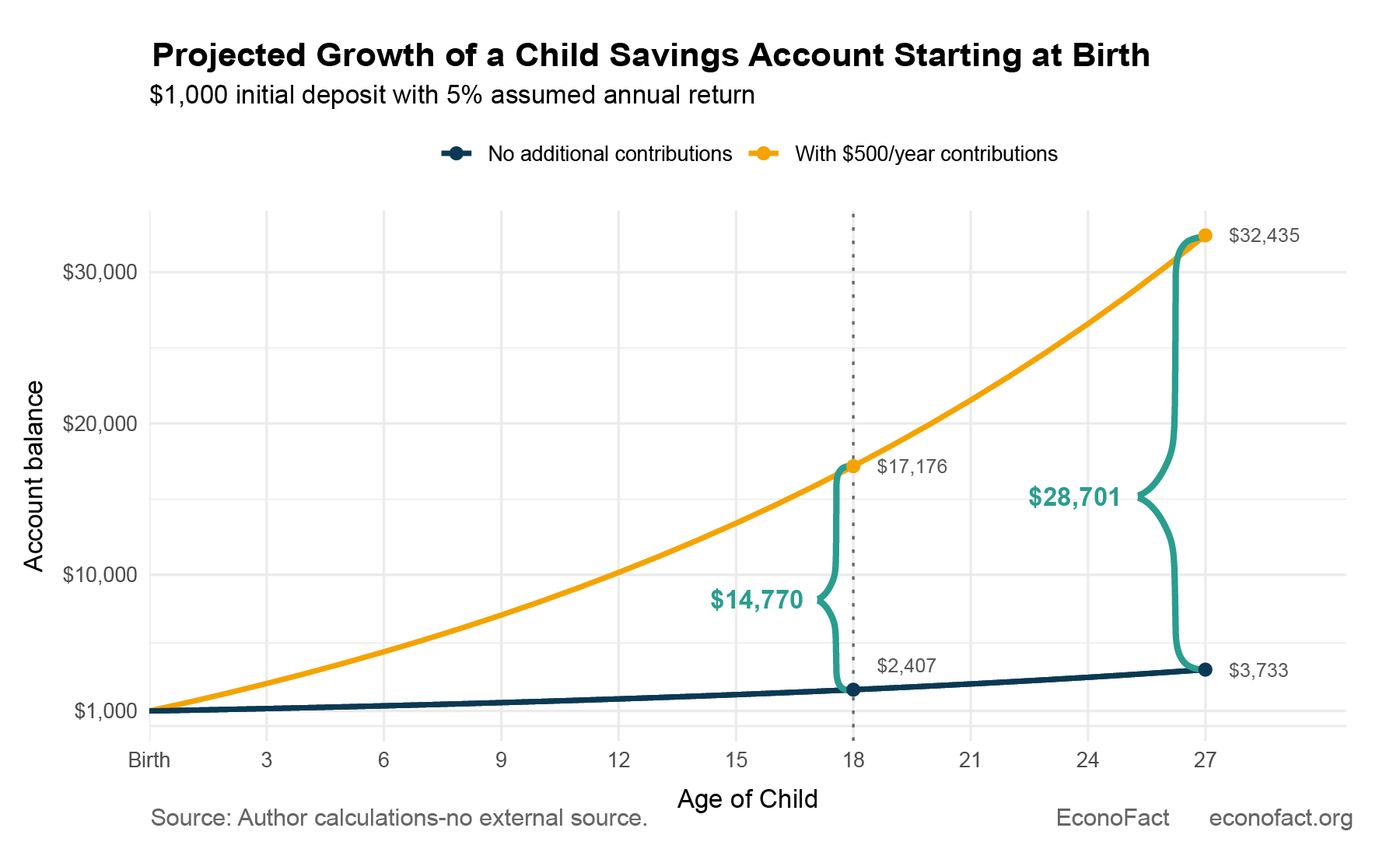
- How much savings grow over time depends on the rate of return and the amount of annual contribution. The Trump administration Council of Economic Advisers estimates that an account opened with the initial $1,000 federal deposit for a child born in 2026 and no additional deposits would have a balance of $5,800 when the child turns 18 under a scenario of “average returns on the U.S. stock market” (estimated at 10.3 percent annual return). If, instead, the annual rate of return is 5 percent, the balance of an account for a child born in 2026 without additional deposits would be $2,407 in 18 years. An annual deposit of $500 increases the balance at 18 by almost $15,000 (see chart).
- Studies of existing child savings accounts find evidence of positive short-term effects. A 2020 GAO review of existing research on over 80 child savings account programs run by states, local governments and non-profit organizations found that the programs increased family enrollment and participation in savings vehicles, increased amounts saved, and raised parental educational expectations of their children. Research on a randomized control study of a child development account program in Oklahoma (SEED OK) found the program helped parents sustain high expectations about their children’s education; reduced symptoms of maternal depression; reduced punitive parenting and improved children’s early social-emotional development (see here). Whether the programs have an impact on college enrollment or other long-term effects on families was unclear because most of the children in participating families had not reached college age at the time of the studies.
- The extent to which child-conditioned accounts can support wealth building among families with low income will depend on the complexity of program enrollment. There is evidence that automatic enrolment is a key program design feature. Programs that require families to opt-in (as opposed to enrolling them automatically) have historically produced lower participation rates, especially among lower-income families. For instance, a Child Development Account piloted in Pontiac, Michigan in the early 2000s offered families of children enrolled in Head Start (an early childhood program available to families with low income) the opportunity to open an account with the MI 529 College Savings Plan with a seed deposit of $1000. After extensive and costly recruiting efforts, only 62 percent of eligible families enrolled. In contrast, a similar pilot program in Oklahoma that automatically enrolled a group of families with newborns with a substantial deposit of $1,000 in 2007 found that 100% of those children still had accounts with income and assets available to go toward their education and other allowable uses 19 years later (see here). Enrollment challenges for families who do not owe federal or state income taxes or who are less familiar with the tax system are likely to be higher for the Trump accounts, which assume opting-in through tax filing and working within the tax system. Families with low income or low wealth may also forgo opening certain types of child-conditioned accounts given tight household budgets, the penalty for withdrawing funds, and risks of losing eligibility for certain other government benefit programs.
What this Means:
Child-conditioned savings and investment accounts can complement other household wealth-building options and strategies. These accounts, typically available through the tax system, incentivize using resources to invest in children’s environments or increase savings for children’s futures (college, home ownership). But they are not a silver bullet. Other public policies can also support wealth building including those targeted to reduce poverty that in turn can enhance income to meet daily consumption needs and free up potential income to go toward savings (e.g. expansions in the earned income tax credit and Medicaid have each been found to increase wealth). Other factors, such as access to credit, pensions, and financial education and information, are also important in shaping wealth-building options and fostering the transmission of wealth across generations. The recently available Trump Accounts get part way there: they offer initial deposits and encourage savings and this particularly can support households with children and low income; other entities can also contribute to these accounts with relative ease. However, they have similar complexity and information barriers as other tax-advantaged accounts that are challenging to navigate without tax expertise, and which may lead to lower participation by low-income families.
Like what you’re reading? Subscribe to EconoFact Premium for exclusive additional content, and invitations to Q&A’s with leading economists.