
Will the New Public Charge Rule Lower Enrollment in Safety Net Programs?
Brookings Institution
The Issue:
On September 18, 2026, a new Department of Homeland Security (DHS) rule is slated to take effect that would greatly expand how public benefit use by non-citizens or their family members can be considered when they apply for a green card or another change in their immigration status. Known as the “public charge rule,” it is based on longstanding immigration policy aimed at excluding immigrants who are believed likely to become dependent on public assistance. How the concept is applied in practice depends on guidelines issued by the executive branch. This is the third major overhaul of “public charge” policy in eight years. The forthcoming rule leaves much more discretion in the hands of individual immigration officers than previous versions, allowing officers to consider a wider range of benefits and benefit usage by the U.S. citizen children of applicants. While the rule itself does not change eligibility criteria for social safety net programs, it can impact the degree to which immigrant families participate in these programs. Households with immigrant members could choose to pull back from benefits to which they are legally entitled for fear of jeopardizing their immigration prospects. Will the new rule meaningfully change enrollment in safety net programs?
Households with immigrant members could pull back from benefits to which they are legally entitled for fear of jeopardizing immigration prospects.
The Facts:
- "Public charge" is a centuries-old immigration screening concept that is intended to determine whether someone is likely to become primarily dependent on the government. It dates to colonial-era laws and has been part of federal immigration statute since the 1800s. In practice, it is primarily applied when someone seeks admission to the United States or applies to adjust their status to legal permanent resident (green card). It is not relevant to applicants seeking legal permanent residence based on their status as refugees or asylees, but DHS has indicated that public charge may be considered in naturalization determinations and could affect the deportability of those arriving within the last five years.
- The new rule, effective September 18, allows broad, case-by-case discretion to immigration officers deciding whether someone applying for a green card is likely to become a "public charge." Since 1999, guidance had defined “public charge” narrowly, covering only the ongoing receipt of cash assistance or government-funded long-term institutional care. Under that standard, using programs like Medicaid or the Supplemental Nutrition Assistance Program (SNAP) would not hinder a non-citizen’s green card application. In 2019, during President Trump’s first term, the public charge rule was overhauled to allow the consideration of participation in non-cash programs like Medicaid and SNAP. But the overhaul was short-lived; a 2022 Biden administration rule reverted to the historical convention. The new rule issued by the current Trump administration rescinds that narrow definition and requires officers to apply a "totality of circumstances" test in green-card and admission decisions. Officers can weigh an applicant's receipt of "any means-tested public benefits" — explicitly including but not restricted to Medicaid and CHIP (Children’s Health Insurance Program), SNAP, WIC (Women, Infants, and Children nutrition program), and housing assistance. In addition, the Department of Homeland Security guidance indicates that officers should consider benefit use by the applicant’s U.S. citizen children if the applicant is legally obligated to support them.
- Undocumented immigrants are ineligible for most federal means-tested benefit programs, and many categories of legal immigrants face restrictions as well. Unauthorized immigrants are not eligible for federal cash assistance programs like the Temporary Assistance for Needy Families (TANF) and Supplemental Security Income (SSI), SNAP food assistance, or the federal non-emergency Medicaid program. There are also restrictions for some categories of legal immigrants, including legal permanent residents who have been in the country less than five years. Some states use their own funds to offer fill-in programs that provide health insurance or other support to federally ineligible immigrants. DHS indicates that these state-funded programs will also be subject to potential consideration by immigration officers under its new approach. Some programs like Head Start and free or reduced-price school lunch have historically not considered immigration status for eligibility. Under the new rule, use of these programs could count against a green card application.
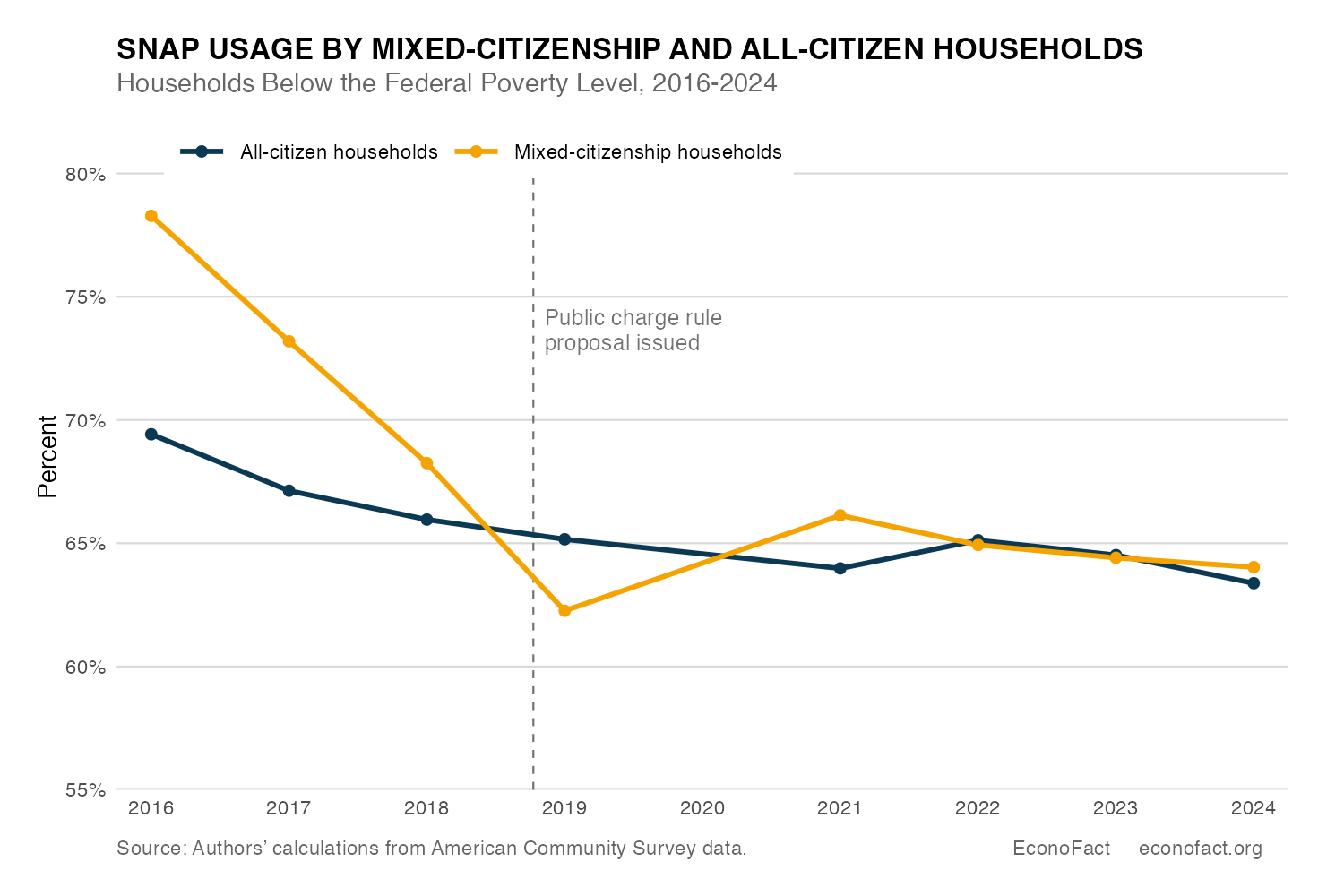
- Recent Brookings estimates using 2023 American Community Survey data find that non-citizens participate in almost all means-tested individual benefit programs at notably lower rates than citizens. In 2023, there were about 9.25 million households with both citizen and non-citizen members (about 6.6 percent of all households). If program participation is measured among households rather than individuals, mixed-citizenship households participate in programs like SNAP at rates at least as high as all-citizen households (see chart). This reflects the fact that benefits reach citizen family members, including U.S.-born children, even when non-citizens are excluded from the program.
- Although many immigrants are ineligible for federal means-tested programs and immigrants tend to participate at lower rates than U.S.-born citizens, prior changes to the public charge rule had a measurable impact on program enrollment. When a more expansive version of the public charge rule was proposed during the first Trump administration in 2018, evidence shows that immigrant families pulled back from SNAP, TANF, and Medicaid even before the rule was enforced. For example, SNAP participation by mixed-citizenship households below the Federal Poverty Level (FPL) was almost 80 percent in 2016, higher than SNAP participation by similar all-citizen households. However, participation in SNAP by mixed-citizenship households dropped sharply between 2016 and 2019 (see chart). A similar Migration Policy Institute analysis of Census data found SNAP and TANF participation among low-income non-citizens fell 37 percent and Medicaid fell 20 percent between 2016 and 2019, with the steepest declines during the 2018 comment period. Other research on the earlier rule found that after the proposal, U.S.-born children with non-citizen parents became less likely than children of U.S.-born parents to participate in SNAP and Medicaid.
- The administration estimates roughly 1.3 million people will disenroll from or forgo enrolling in seven major benefits programs and that there will be a $13 billion annual reduction in program expenditures as a result of the new rule. The rule's expected effect on program enrollment comes not from eligibility changes, but from dissuading eligible people from participating. The new rule is considerably more open-ended than the standard it replaces, with no fixed dollar or time threshold for benefit participation counting against an applicant, and no clarity on how benefit usage is weighed against other factors. This vagueness is likely to exacerbate the chilling effect. A Kaiser Family Foundation report estimates that at least 1.4 million people, including nearly 600,000 citizen children, could disenroll from Medicaid due to chilling effects.
- The new public charge rule is only one piece of a broader set of policy changes that are working to restrict immigrants' access to public benefits. Statutory changes in the 2025 reconciliation law cut lawfully present immigrants' eligibility for SNAP, Medicaid, and Affordable Care Act premium tax credits. HUD has proposed denying housing assistance to an entire family if any member is ineligible, and other agencies have expanded which programs count as a "federal public benefit" (therefore limiting eligibility for many immigrant groups) while also narrowing longstanding exceptions that had let non-citizens receive certain emergency aid regardless of status.
What this Means:
The new public charge rule gives immigration officers broad discretion about how the use of public benefits by the applicant or their family members are considered in green card determinations and some other status adjustments. It will likely lead many eligible people — including U.S. citizen children— to disenroll from or avoid applying for benefits out of fear or uncertainty. Evidence from the 2019 rule suggests this chilling effect could be substantial, in line with DHS's own projection of 1.3 million people disenrolled.
Like what you’re reading? Subscribe to EconoFact Premium for exclusive additional content, and invitations to Q&A’s with leading economists.