Taxing Domestic and Multinational Corporations
The Brookings Institution
Executive Summary
Corporate taxation must balance raising adequate revenue while minimizing distortions to business decisions. The corporate income tax is an essential component of the federal tax system, raising roughly $450 – $500 billion annually, or about 8 to 10% of total tax receipts. Taxes also inevitably influence behavior. As a result, policymakers often use the corporate tax to encourage specific activities, such as domestic investment, employment, innovation, and clean energy production. These objectives are more difficult to achieve in a global economy in which corporations can choose where to locate headquarters, productions, and sales. In this context, the corporate tax must also limit incentives for firms to shift profits abroad to reduce their tax bills while maintaining the United States as an attractive place to invest and do business. This Explainer examines how the U.S. corporate tax system operates in the light of these goals, with particular attention to recent tax legislation and the taxing of multinational corporations.
I. Basics of the U.S. Corporate Tax
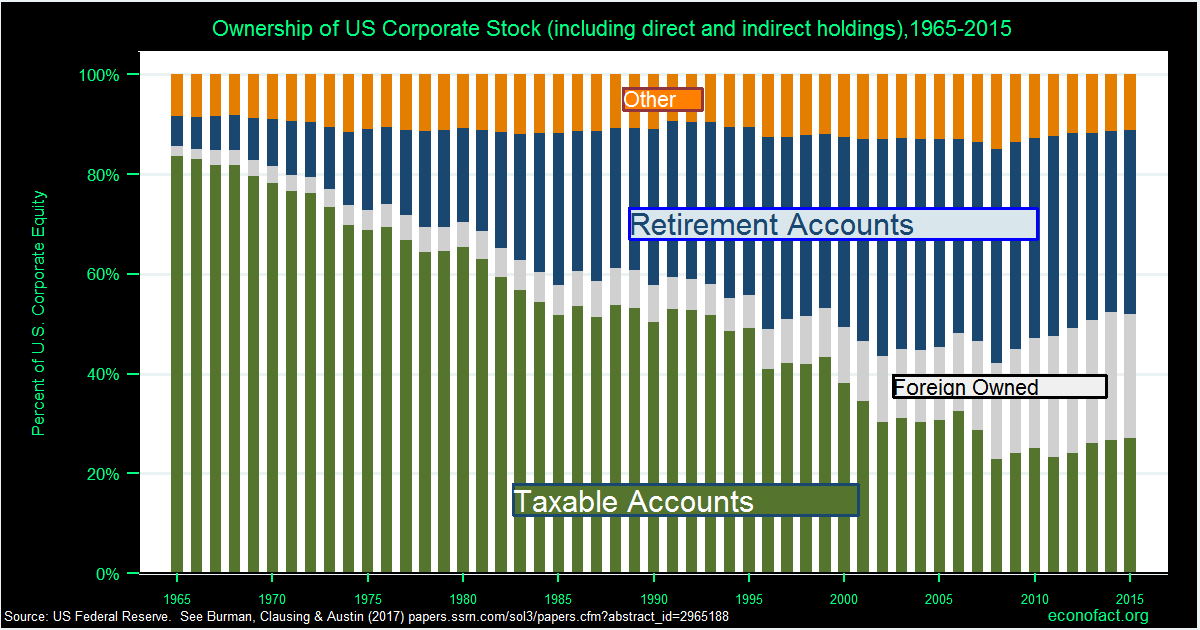
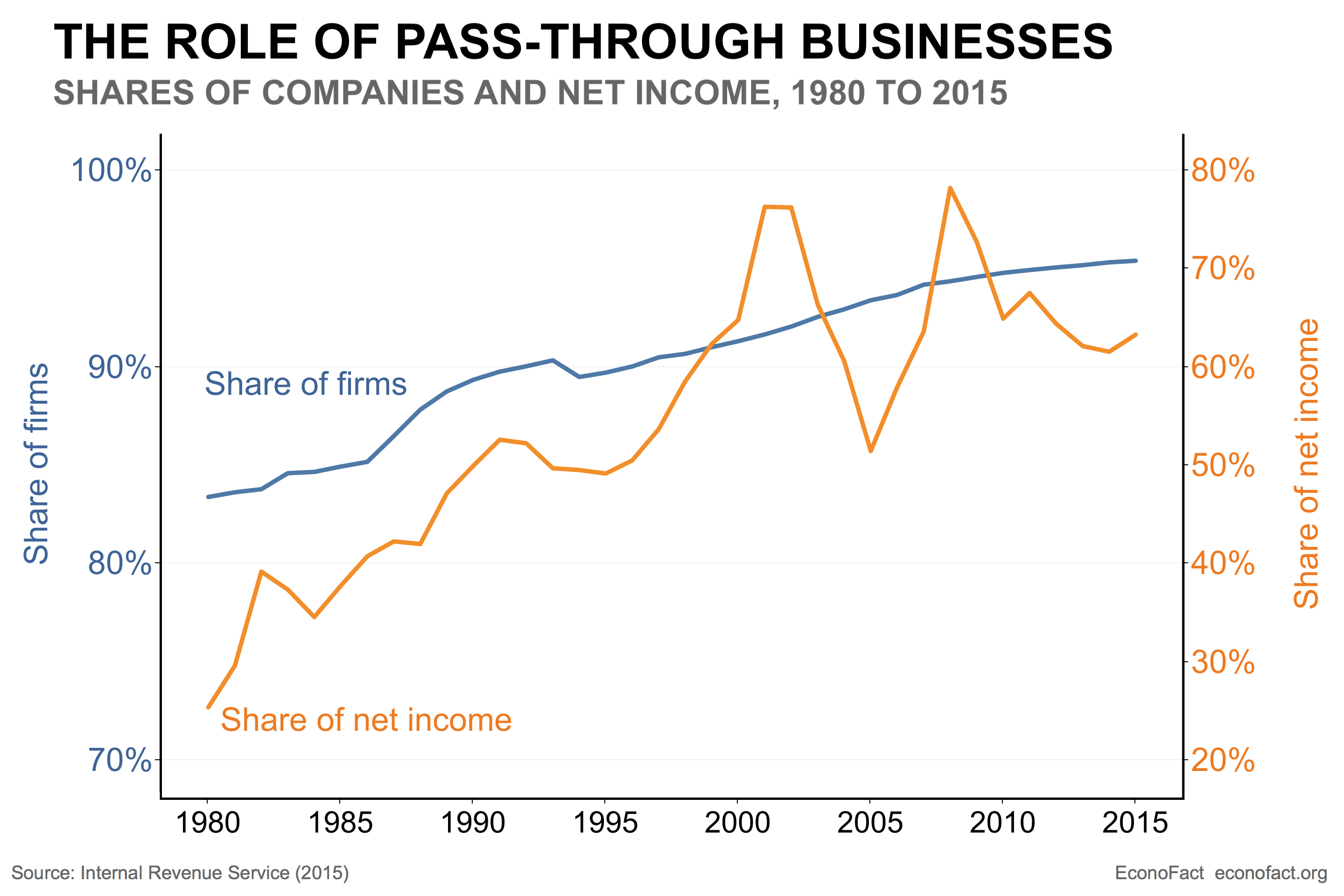
The Corporate Income Tax applies to C corporations. These are traditional companies organized as separate legal entities from their owners. All publicly traded firms must be organized as C corporations, but C corporations also include many privately held businesses, large and small. Examples include well-known publicly traded companies like Alphabet, Apple, General Electric, Home Depot, UnitedHealth Group, and Walmart, some of which primarily operate in the United States while others conduct substantial business abroad. Out of roughly 1.5 million C corporations, only several thousand are publicly traded. At the same time, corporate tax payments are highly concentrated, with just 2,614 corporations holding an average of $2.5 billion in assets — many of which are publicly traded — accounting for roughly 80% of total federal corporate income tax receipts in 2022. Corporations with significant cross-border operations are subject to a distinct and complex set of multinational tax rules, discussed below. The corporate tax does not apply to pass-through entities like partnerships (like many large law firms or doctor’s groups), S Corporations (like Hobby Lobby), or Sole Proprietorships (which include many small, single-owner businesses). These firms are all structured to pass business income through to their owners’ individual tax returns. The most recent United States tax legislation includes the introduction of bonus depreciation in 2002, the 2017 Tax Cuts and Jobs Act (TCJA), the 2022 Inflation Reduction Act (IRA), and the 2025 One Big Beautiful Bill Budget Act (OBBBA). These 21st century legislative landmarks of corporate tax policy are discussed in the box.
There is a distinction between statutory and effective tax rates. Corporations are taxed on their income, but the income they report to shareholders (book income) and the income they report to the IRS (taxable income) are defined differently. Book income follows Generally Accepted Accounting Principles (GAAP) to convey a firm’s economic performance. Taxable income is defined by the Internal Revenue Code (IRC) to reflect policy choices about what should be taxed — and when — and is affected by features of the tax code such as deductions, credits, and loss carryforwards, as well as the complex rules governing the taxation of multinational profits. This distinction gives rise to the difference between the statutory tax rate and the effective tax rate (ETR). The current 21% statutory corporate tax rate, established by the 2017 Tax Cuts and Jobs Act, broadly aligns the U.S. corporate tax rate with rates in other advanced economies. It is a flat rate, meaning that it is the same regardless of the level of income. By contrast, a corporation’s effective tax rate measures the share of income it actually pays in taxes. Effective tax rates are often substantially lower than statutory rates, reflecting the same deductions, credits, loss carryforwards, and international tax rules that affect taxable income.
A number of key deductions and credits affect the effective tax rate. Several features of the tax code reduce taxable income or tax liability. One key deduction is depreciation, which allows firms to deduct the cost of capital investments over time following IRS-determined schedules. Past legislation has frequently allowed certain types of investment to be depreciated more quickly than under standard schedules under a policy known as accelerated depreciation. Under the One Big Beautiful Bill Act (OBBBA), the full cost of certain types of investment can be deducted in the year of investment under a policy known as full expensing. Another important deduction is interest expense; businesses may deduct interest paid on debt, subject to certain limitations. They may also deduct prior-year losses, allowing firms with negative taxable income in one year to carry losses forward to offset future positive taxable income. In addition to deductions, specific business activities generate tax credits, which directly reduce taxes owed. Major credits apply to activities such as research and development, low-income housing development, and clean energy production. For multinational corporations, foreign tax credits offset taxes paid to foreign governments and help prevent double taxation of foreign earnings (more on this below). These features contribute to the gap between statutory and effective tax rates. The Government Accountability Office (GAO) estimated that the average effective corporate tax rate among profitable large corporations fell from 16% in 2014 to 9% in 2018. This gap reflects the combined effect of loss carryforwards, accelerated depreciation of capital expenses, tax credits, and the lower effective tax rates that multinationals often face on certain forms of highly mobile foreign income.
Deductions and credits influence corporate behavior in key ways. Although the corporate income tax is often evaluated against a benchmark of minimizing distortions, policymakers have long used deductions and credits to encourage specific activities. Accelerated depreciation and full expensing are intended to encourage investment by lowering the after-tax cost of capital. The deductibility of interest expense reduces the tax cost of borrowing, though it may also encourage higher leverage. Loss carryforwards allow firms with volatile or cyclical earnings to smooth tax liabilities over time, helping ensure that taxes are imposed on long-run profitability rather than year-to-year fluctuations in earnings. By contrast, tax credits are typically targeted more narrowly, with the explicit goal of promoting certain activities — especially those that may have positive spillovers like research and development or clean energy production.
Some corporations pay no corporate income tax. Each year, a significant share of large, profitable corporations owe zero federal tax. The GAO estimated that roughly two-thirds of all corporations owed no federal tax in 2018, the last year this estimate is available; among large corporations this share was 58% and among large, profitable corporations it was 34%. Importantly, zero tax liability paired with positive book income does not necessarily indicate tax evasion (which is illegal, as opposed to tax avoidance, which complies with the rules and regulations). Common legitimate reasons for winding up in a zero-tax liability position include: legitimate business losses, large carry-forward losses from a prior year, accelerated depreciation from large capital investments, large tax credits, and international tax provisions. While these deductions and credits are all within the rules, this fuels the perception that corporations “do not pay their fair share,” and led to policies like the Corporate Alternative Minimum Tax (CAMT). The TCJA repealed the CAMT in favor of limiting the amount of taxable income that could be reduced by loss carryforwards. The 2022 Inflation Reduction Act introduced a new CAMT that imposes a 15% minimum tax on corporations with more than $1 billion in book income. Importantly, CAMT continues to permit low effective tax rates due by allowing certain business tax preferences, including accelerated depreciation. For this reason, critics argue that the CAMT is unlikely to raise significant revenue.
Tax neutrality is a benchmark for evaluating corporate tax policy. A central issue in evaluating tax policy is the extent to which the tax system influences business decisions. One common benchmark for this is tax neutrality, which refers to a system in which taxes do not distort firms’ underlying economic decisions about how and where to invest — such as whether to buy equipment or build a factory, hire workers, or finance operations with debt or equity. When the tax code favors one form of investment or business structure over another, resources can be misallocated, potentially reducing overall productivity and economic growth. At the same time, corporate tax policy often deliberately departs from neutrality. Policymakers use deductions, credits, and other provisions to encourage activities that firms might otherwise undertake less of, such as research and development and clean energy production, or other activities believed to generate broader social benefits. These incentives reflect the tradeoffs between efficiency, revenue, and other policy objectives. Understanding these tradeoffs is essential to evaluating how the corporate tax system operates in practice.
II. Taxing Multinational Corporations
Multinational corporations operate across national borders, complicating the design of the tax system. Multinational corporations conduct management, sales, production, and other types of business activities in multiple countries. Operating across borders can create tax planning opportunities, including locating operations abroad, shifting reported income to lower-tax jurisdictions, and recording liabilities in higher-tax jurisdictions.
International tax norms shape how countries tax multinational income. The international tax system is generally guided by two core principles: 1) The jurisdiction in which income was earned has the first right to taxation; 2) Income should not be taxed more than once. Applying these principles becomes more complex when corporations operate across borders and multiple tax systems interact, complicating the goals (discussed above) of raising tax revenue while minimizing distortions to economic activity. Countries take different approaches to taxing multinational income according to these principles. Under a worldwide tax system, individuals and corporations are taxed on all income, regardless of where it is earned, with credits provided for foreign taxes paid to avoid double taxation. Under a territorial tax system, countries tax only domestically-earned income and generally exempt foreign income from the tax base, also avoiding double taxation. Most OECD countries have territorial corporate tax systems.
The TCJA and OBBBA moved the U.S. from a worldwide system toward a hybrid approach to taxing multinational income. Until recently, the U.S. operated a worldwide corporate tax system under which U.S. multinationals were subject to U.S. tax on their global income, with credits for foreign taxes paid. Under that system, firms could defer U.S. tax on foreign earnings by keeping earnings in foreign subsidiaries rather than bringing earnings (or repatriating earnings) back to the U.S. Some estimates suggest that more than $1 trillion in corporate earnings were held off-shore under this regime (Clausing 2016). The TCJA, followed by further refinements under the OBBBA, shifted the U.S. away from a purely worldwide system towards a hybrid approach that combines a partial exemption of foreign income with continued taxation of certain foreign earnings. Under this hybrid system, some foreign income earned by controlled foreign corporations is included in the U.S. tax base under the Net-Controlled Foreign Corporation Tested Income (NCTI) regime, reflecting a continued worldwide element of the system. The U.S. also retains base erosion protections, including the Base Erosion and Anti-Abuse Tax (BEAT), which limits the deductibility of certain cross-border payments that could otherwise reduce U.S. taxable income. In addition, certain income associated with serving foreign markets receives preferential tax treatment under the Foreign Derived Intangible Income (FDII) regime. Together, NCTI, BEAT, and FDII define how the U.S. hybrid system balances exemption of some foreign income with continued worldwide taxation and anti-avoidance protections.
Allocating taxing rights across countries is a central challenge of international tax policy. When firms operate across borders, tax authorities must determine how a single multinational’s income should be divided across countries — that is, which jurisdictions have the right to tax which portion of a firm’s profits. This question lies at the core of international tax policy. The allocation of income is well-established for profit associated with activities tied to tangible assets, such as factories, equipment, which can be clearly located in a particular country. It is far more difficult to apply existing norms to income derived from intangible assets, including patents, trademarks, software, and other intellectual property, which are highly mobile and increasingly important in a global, digital economy. These difficulties in allocating income across borders provides the backdrop for on-going policy debates and responses, including concerns about profit shifting and the emergence of digital services taxes.
Profit-shifting and transfer pricing shape how multinationals strategically respond to international tax systems. They can reduce their global corporate tax bill by shifting reported profits from high-tax to low-tax jurisdictions. A key mechanism for profit shifting is transfer pricing, which refers to the prices charged for transactions between related entities in the same organization. Tax rules generally require that these internal prices reflect “arms length” transactions — or the price that would be charged between unrelated parties — but there is substantial room for interpretation, especially for unique intangible assets like patents. Common profit-shifting strategies include locating valuable intellectual property in low-tax countries and concentrating debt in high-tax countries to maximize the value of interest deductions. For example, differences in national tax systems — including relatively low statutory corporate tax rates in some jurisdictions and for some forms of income — have made certain countries relatively attractive locations for reported profits and intellectual property. Estimates suggest that these profit shifting tactics cost the U.S. more than $100 billion per year (Clausing 2016).
Tax competition shapes how countries design their corporate tax systems. Countries respond to other countries’ tax systems. This tax competition reflects efforts to attract multinational corporate activity in order to promote employment, raise revenue, and contribute to the national economy. Because some multinational investment is highly mobile, governments face incentives to lower corporate tax rates or offer preferential tax treatment to attract capital. As a result, corporate tax rates have declined across many countries over recent years, often described as a “race to the bottom” that has eroded the global corporate tax base. While lower rates may improve competition, they can also significantly reduce government revenues that are needed to finance government services. Striking the right balance between maintaining competitiveness and preserving revenue is a central challenge of corporate tax policy and has motivated international coordination efforts like the OECD’s global minimum tax framework.
Legislative Landmarks
- 2002 — Temporary Introduction of Bonus Depreciation
First introduced as a temporary economic stimulus after the 2001 recession, bonus depreciation allows companies to immediately deduct a portion of their capital investment costs, rather than taking these deductions over time. Initially set at 30%, the provision was frequently extended, expanded, and re-introduced, with availability from 2002 – 2004 and 2008 – 2017. When bonus depreciation reaches 100%, the policy allows companies to deduct the full cost of an asset in the year it is produced and is referred to as full expensing or, more simply, expensing. - 2017 — Tax Cuts and Jobs Act. The TCJA represented the most significant corporate tax reform in decades. Key provisions include: rate cut (reduced from 35% to 21%); interest limitations (capped interest deductions based on pre-tax profit measure); extension of Bonus Depreciation through 2022; GILTI (Global Intangible Low Tax Income, minimum tax on foreign income exceeding 10% return on tangible assets); FDII (Foreign Derived Intangible Income, lower tax rate for certain export income exceeding 10% return on tangible assets); BEAT (Base Erosion and Anti-Abuse Tax, minimum tax preventing profit shifting).
- 2022 — Inflation Reduction Act. The IRA included a re-designed Corporate Alternative Minimum Tax (CAMT), which imposes a 15% minimum tax on corporations earning more than $1 billion in average annual book income, targeting large corporations with low tax bills but large book income.
- 2025 — One Big Beautiful Bill Act. While largely focused on individual tax provisions, the OBBBA included a few key business provisions: permanent expensing; expanded interest deduction; expensing for research and experimentation; international modifications to re-orient multinationals towards domestic investment (GILTI, renamed NCTI, eliminated tangible asset return adjustment while expanding foreign tax credit limits to reduce relative advantage of earning income abroad; FDII, renamed FDDEI, removed tangible asset requirement and expanded benefits to operate as a more explicit export subsidy.)
III. Key Policy Debates
Revenue, Fairness, and Neutrality: Effective tax rates that fall below the 21% statutory rate raise questions about both fairness and efficiency. Some view low rates as evidence that credits and deductions successfully promote investment and competitiveness. Others argue that large, profitable corporations should face a minimum level of taxation to preserve equity and confidence in the system. These concerns are reflected in ongoing debates over policies like the Corporate Alternative Minimum Tax (CAMT), which seeks to ensure that large corporations with substantial earnings pay at least a minimum amount of tax. At the same time, tax neutrality remains an important organizing principle for corporate tax policy. Provisions affecting the tax treatment of investment (such as accelerated depreciation) are often justified on neutrality grounds, as they aim to reduce tax-induced distortions to firms’ investment decisions. Balancing these objectives while ensuring the corporations contribute an appropriate share of revenue remains a core challenge of corporate tax policy.
Maintaining the Competitiveness of the U.S. Corporate Tax:
Corporate tax policy also affects where firms locate profits, capital, and real activity. If U.S. rates or rules are significantly out of line with other advanced economies, businesses may shift activity abroad or engage in profit shifting through transfer pricing and intangible income. The TCJA and OBBBA reforms sought to balance these pressures by lowering the statutory rate, broadening the base, refining international provisions to reduce incentives to hold profits offshore and to encourage domestic investment. Evidence on the extent to which the TCJA reforms achieved these goals is mixed, with some indicators pointing to changes in repatriation behavior and investment patterns, and others suggesting more limited or uneven effects (Chodorow-Reich, Zidar, and Zwick 2024, Clausing 2024).
International Coordination and the Global Tax Deal: International coordination remains important. The OECD/G20 global tax framework seeks to address the coordination challenges of taxing multinational firms through two main pillars: a 15% global minimum tax (Pillar Two) and new rules allocating taxing rights over a portion of multinational profits based on where their customers and users are located (Pillar One). In January 2026, the OECD and U.S. Treasury announced a revised global minimum tax agreement under which U.S.-headquartered multinational companies would be effectively exempt from most aspects of the the Pillar Two 15% minimum regime, allowing U.S. firms to continue operating under global minimum tax rules rather than being subject to the OECD mechanism that has moved forward in many jurisdictions. The profit-reallocation component of the OECD framework under Pillar One has not yet taken effect. Its implementation depends on a multilateral agreement that requires approval in key countries, including the United States, and that approval has not yet occurred.
IV. Conclusion
The central policy questions concern how the corporate tax can raise needed revenue while promoting efficient, competitive, and fair outcomes for both domestic and multinational businesses:
Revenue: Can the corporate tax raise sufficient revenue without discouraging productive investment?
Neutrality: To what extent should the code favor specific industries or activities, and when do such preferences undermine efficiency?
Fairness: Should policies like minimum taxes be in place to ensure that all companies pay a minimum amount of tax?
Competitiveness: Has the U.S. struck the right balance between attracting investment and protecting the domestic tax base?
Coordination: How should the U.S engage with global tax agreements?
Further Reading
Lautz, A. (2026). International Tax Policy: Where the U.S. Stands and What’s Ahead in 2026. Bipartisan Policy Center
Patel, E. (2025). ‘Econ 101’ Briefing on Taxing Multinationals Brings Hill Staffers Up to Speed on the U.S. Role in Coordinating Global Crack-Down on Tax Avoidance. Washington Center for Equitable Growth
Council of Economic Advisors (2025). Economic Report of the President Chapter 3: Aligning the International Tax System with a Globalized Economy. Economic Report of the President
Brosey, T. (2025). A Review and Assessment of the Main Business Tax Provisions of the 2025 Reconciliation Act. Tax Policy Center
Brosey, T. (2025). A Primer on Digital Services Taxes and the OECD’s Two Pillars. Tax Policy Center
Brosey, T. (2025). The TCJA’s Impact on Foreign Investment Tax Incentives. Tax Policy Center
Chodorow-Reich, G., Zidar, O., & Zwick, E. (2024). Lessons from the biggest business tax cut in US history. Journal of Economic Perspectives, 38(3), 61-88
Clausing, K. A. (2024). US International Corporate Taxation after the Tax Cuts and Jobs Act. Journal of Economic Perspectives, 38(3), 89-112.
Patel, E. (2024). The Corporate AMT: Understanding low tax liabilities as a policy choice. Brookings Institution
Clausing, K. A. (2016). The effect of profit shifting on the corporate tax base in the United States and beyond. National Tax Journal, 69(4), 905-934.Sources